

Sortable List / Sortable List View
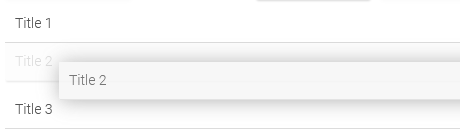
In the "Sortable List" element, you can use drag-and-drop to reorder the entries in the browser as you like. If the sortable list is linked to a data field, you can select an entry and save the value using the corresponding button in the data field. If the page containing the sortable list displays an existing record, the corresponding saved value is automatically selected in the list.
The "Sortable List View" element behaves like the "Sortable List" element, but selected entries cannot be saved.
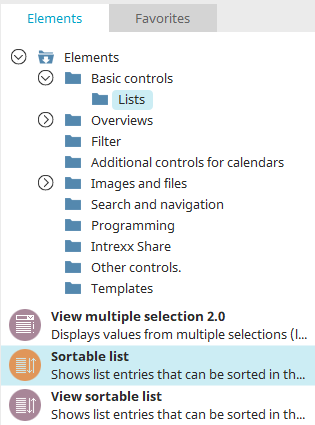
You can find these elements in the "Applications" module, in the "Elements" section, under the "Basic Controls" category in the "Lists" section. You can create a new element by dragging and dropping it from here onto the workspace.
For more information on creating elements, click here.
The properties dialog for a sortable list opens automatically when a new item is created. You can open the Properties dialog box for an existing element by double-clicking the element on the workspace, selecting "Properties" from the context menu, or choosing "Edit / Properties" from the main menu when the element is selected on the workspace.
Create a New Sortable List
General
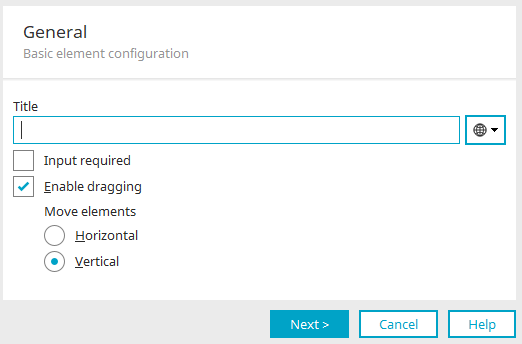
Title from "Constant"
Enter the title of the sortable list here. You can find more information on this topic here.
Input Required
With this setting, the sortable list becomes a required field.
Enable moving
Allows you to sort the list in the browser using drag-and-drop.
Horizontal / Vertical
Specifies whether entries can be moved horizontally or vertically.
Click "Next."
Entries
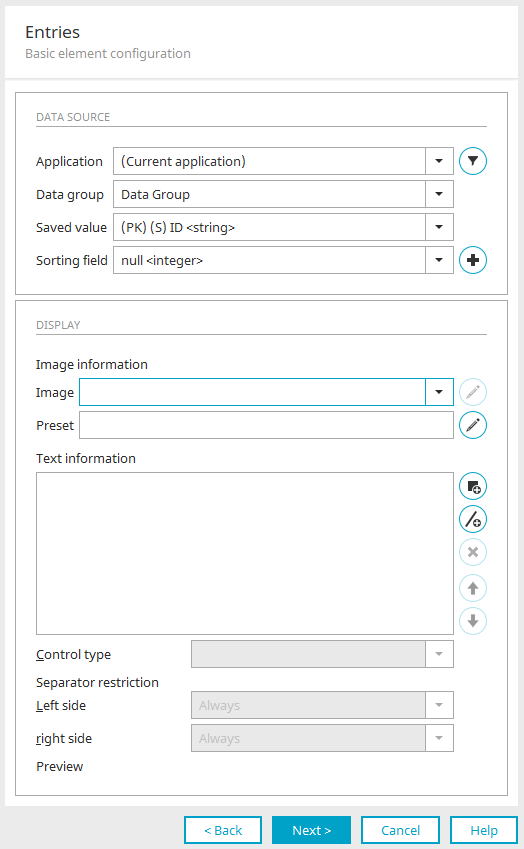
This option uses data from the data groups of applications as entries. The data can also be filtered if only a subset of it is to be selectable from the list.
You also have the option to specify a saved value as the source and use a different value from the same data set for the entry in the list (e.g., User ID as the saved value, username as the display value in the list).
Data Source
Application, Data Group, Stored Value
Select the application, data group, and data field here whose stored value you want to use as an entry.
 Filter
Opens a dialog box where you can define a filter.
Sort Field
Select an existing data field here in which the current order of the list will be saved, or click "  " and then "Create New Data Field" to create a new sort field. You can find information about the dialog that follows here.
Please do not use an existing field from your application—one in which you have already stored data—as the sort field. During a sort operation, this data would be overwritten in the list with the sort order value.
Presentation
Image Information
Image
Here, you can select a data field with the "File" data type that contains links to images.
 Edit Image Options
Opens a dialog box where you can edit the image format.
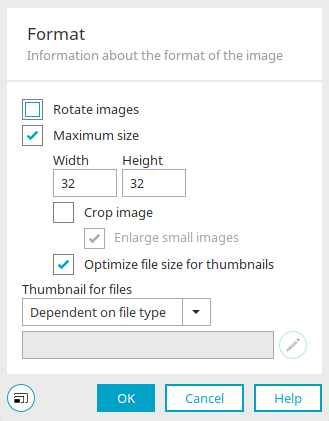
You can find all the information about these settings here.
Click "OK" to save the changes and close the dialog box.
Specification
The image entered here will be displayed if no image is available in the browser when creating a new record.
Text Information
This is where you can include the data fields whose values you want to display in the list.
Control Type
Select the validation type for the text information here.
Restriction Separator
Here, the display for individual separators can be suppressed if the displayed values are empty.
-
Always
A separator is always displayed to the left or right of the text information.
-
Text is not empty
A separator is displayed to the left or right of the text if the entire area to the left or right of the text is not empty.
-
The data field is not empty
A separator appears to the left or right of the text information if the data field immediately to the left or right of the text information is not empty.
Preview
Below, you'll see a preview of the list showing the current settings for text information and separators.
Click "Next."
You can then specify the data field in which the selected entry from the list should be saved. You can find more information here.
After clicking "Next," you'll be taken to the final settings. Click "OK" there to complete the configuration of the sortable list.
Create a new "sortable list view"
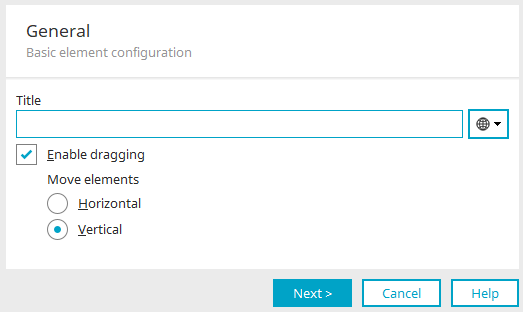
Here, you can configure the same settings as when creating a new "sortable list"—with the exception of the "Required" setting.
Click "Next."
The settings that follow correspond to the settings you can edit when creating a "sortable list."
More Information
Functions of the sortable list with the "Image URL" control type