

Drop-down list / List box
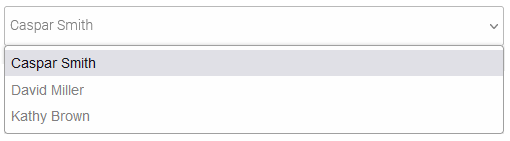
Selection lists are used to display entries in list form.

The list box functions like a drop-down list, but displays the entries in the browser in an open view.
Both input controls are part of the basic controls and can be found there under "Lists." The selection can be saved using the corresponding button, provided that a data field is linked to the element.
The entries in drop-down lists and list boxes can come from various data sources.
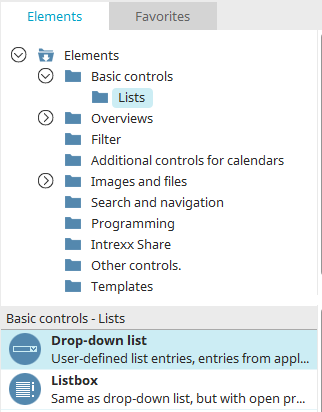
You can find the elements in the "Applications" module under "Elements. " You can create a new element by dragging and dropping it from here onto the workspace.
For more information on creating elements, click here.
The Properties dialog box for a drop-down list or list box opens automatically when a new item is created. You can open the Properties dialog box for an existing element by double-clicking the element on the workspace, selecting "Properties" from the context menu, or choosing "Edit / Properties" from the main menu when the element is selected on the workspace.
Create a new shortlist
General

Title
Enter the title of the shortlist here. You can find information about multilingual titles here.
Show Titles Under Control
Controls how the title is displayed in the input field when viewed in the browser.
Input Required
The drop-down list will become a required field.
The first entry in the list is empty
Inserts a blank entry in the drop-down list before the other entries.
Display as a slider

Causes the drop-down list to be displayed as a slider on the web. The values that will later be defined for the selection list are used for the controller's scale.
Click "Next."
Entries - Values from Applications

This option uses data from the data groups of applications as entries. The data can also be filtered if only a subset of it is to be selectable from the list.
You also have the option to specify a saved value as the source and use a different value from the same data set for the entry in the list (e.g., User ID as the saved value, username as the display value in the list).
Application, Data Group, Stored Value
Select the application, data group, and data field here whose stored value you want to use as an entry.
 Filter
Opens a dialog box where you can define a filter.
 Data Picker
The Data Picker transfers the values selected from the drop-down list to input fields located on the same page. If, for example, you have selected the "Users" system application as your data source, you can use this feature to transfer the username to any field on your application page.
Clicking "Data Picker" at opens a dialog box where you can configure the data mapping.
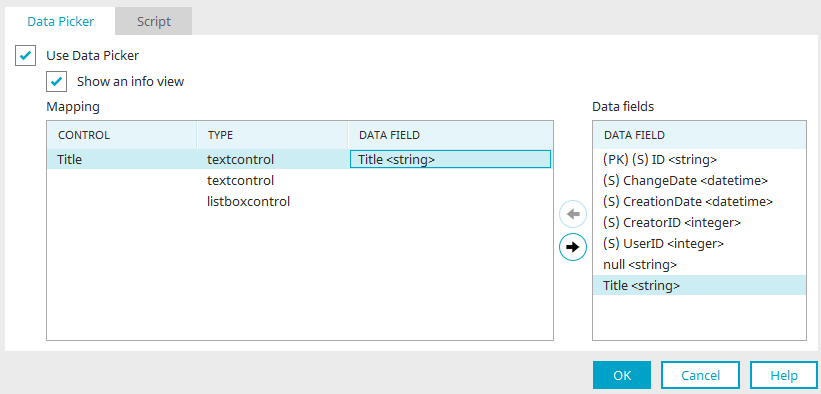
Using the Data Picker
Enables the mapping.
Show an info window
With this setting, a message is displayed both when the assignment fails ("No record found") and when records are found (e.g., "One record found and inserted").
Assignment
All of the page's input elements are listed here.
Data Fields
All available data fields are listed here.

 Establish / Remove Association
Establishes or removes the mapping between a data field and a control.
Click "OK" to save the settings and close the dialog box.
Hide duplicate entries
Ensures that duplicate values in the linked data field are displayed only once in the list. A DISTINCT query is executed in the database to filter the records.
Maximum number of entries
Limits the number of entries in the list. If you enter -1, all entries will be displayed.
Sorting
Displays the currently selected sort order.
 Sorting
Opens a dialog box where you can edit the sort order.
Adjust the display value to match the stored value
The values from the data field you selected in the "Values from Applications" section are used for display. If this setting is not enabled, you can specify the display values yourself. The value stored is the one from the data field you selected in the "Values from Applications" section.
Display value
Displays the currently set display value.
Display value
Opens a dialog box where you can select the data fields that will provide the values.
Values from References
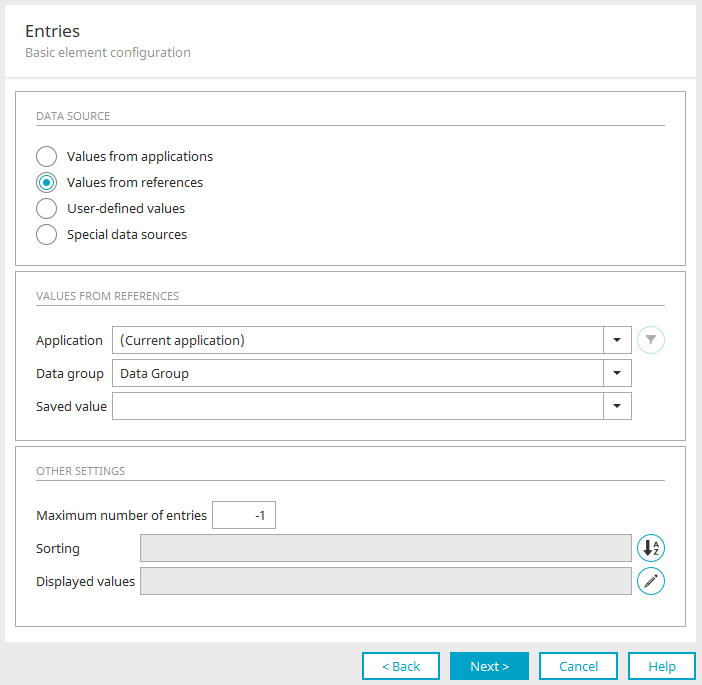
With the "Values from References" setting, you can select references from the current application or from other applications as the source for the entries in the drop-down list. The settings are essentially the same as those for the "Values from Applications" data source.
Custom Values
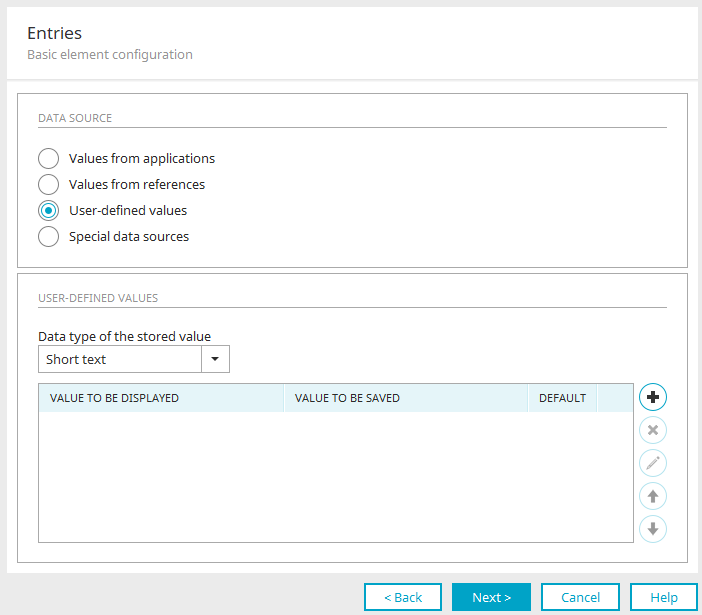
Custom values are entries that do not come from a data source but are entered statically.
Data type of the stored value
Specify the data type of the stored value here.
 Add a new custom value
Opens a dialog box where a new value can be entered.
 Delete Custom Value
The selected entry will be removed.
Edit Custom Value
Opens a dialog box where the value can be edited.

 Move the value further up or down in the display order
Changes the order of the entries.
Preselection
The entry marked in the "Preselection" column will be preselected when the page loads.
Special Data Sources
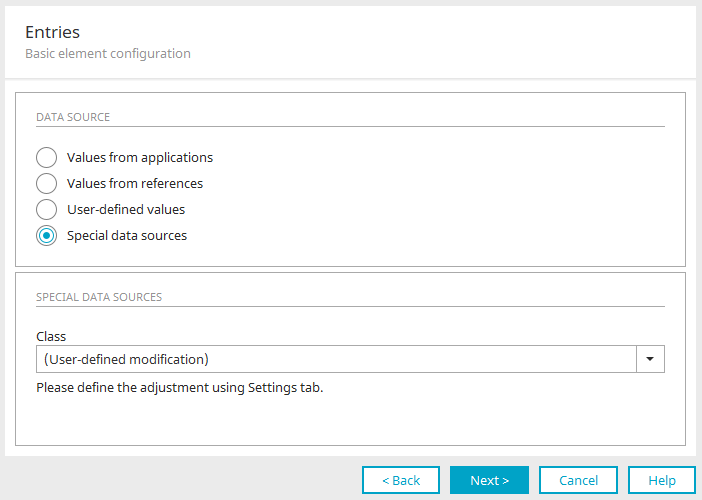
Here, you can select class names that provide the entries in the drop-down list.
|
Class |
Displayed value |
Stored value |
|
Customization |
This selection is used for internal adjustments to settings |
|
|
CountryListProcessor |
Country Names |
Country Code |
|
DsContainerListProcessor |
GUID of the container object |
|
|
DsCustomClassListProcessor |
User-defined classes. If no class is specified in the settings, users are returned. To ensure that classes are delivered, the desired class ID must be specified via a setting: control.listbox.dsClassId for drop-down lists and list boxes control.dynamicControl.dsClassId In Dynamic View |
Class ID |
|
DsDistListListProcessor |
GUID of the distribution list |
|
|
DsGroupListProcessor |
User group GUID |
|
|
DsOrgUnitListProcessor |
GUID of the organizational unit |
|
|
DsOrganizationListProcessor |
Organization GUID |
|
|
DsRoleListProcessor |
Role GUID |
|
|
DsUserProcessor |
User GUID |
|
|
LanguageListProcessor |
Using the "control.listbox.language.usePortalSettings" setting, you can also display only the languages that are enabled in the portal. You can find more information here. |
Language code |
|
LocaleListProcessor |
Language code combined with country code |
|
|
PortalGroupLanguageListProcessor |
Languages, with the languages enabled in the portal listed at the top of the list and the disabled ones listed below. |
Language code |
|
TimezoneListProcessor |
Time Zone |
Click "Next" once you have finished configuring the desired data source.
You can then specify the data field in which the selected value from the list should be saved. You can find more information here.
After clicking "Next," you'll be taken to the final settings. Click "OK" there to complete the configuration of the drop-down list.
Create a New List Box
General

Title
Enter the title of the list box here. You can find all additional information on this topic here.
Input Required
The list box becomes a required field.
The first entry in the list is empty
Inserts a blank entry before the remaining entries.
HTML element

In addition to the default setting, list boxes can also be displayed as "unordered lists" in the browser.
Width / Height
If the list box is set to "Unordered List," you can also specify the sizing behavior of the control.
-
Maximum: The list box is displayed in the browser at a maximum width or height as defined in the Portal Manager.
-
Minimum: The list box is displayed in the browser at the minimum width or height defined in the Portal Manager.
-
Fixed: The list box is displayed in the browser with the exact same width and height as defined in Portal Manager.
When the list is displayed as an "unordered list," the "First entry in the list is empty" option is not available.
Click "Next." The following dialog boxes correspond to those that appear when creating a selection list. The same settings are available for the list box.