

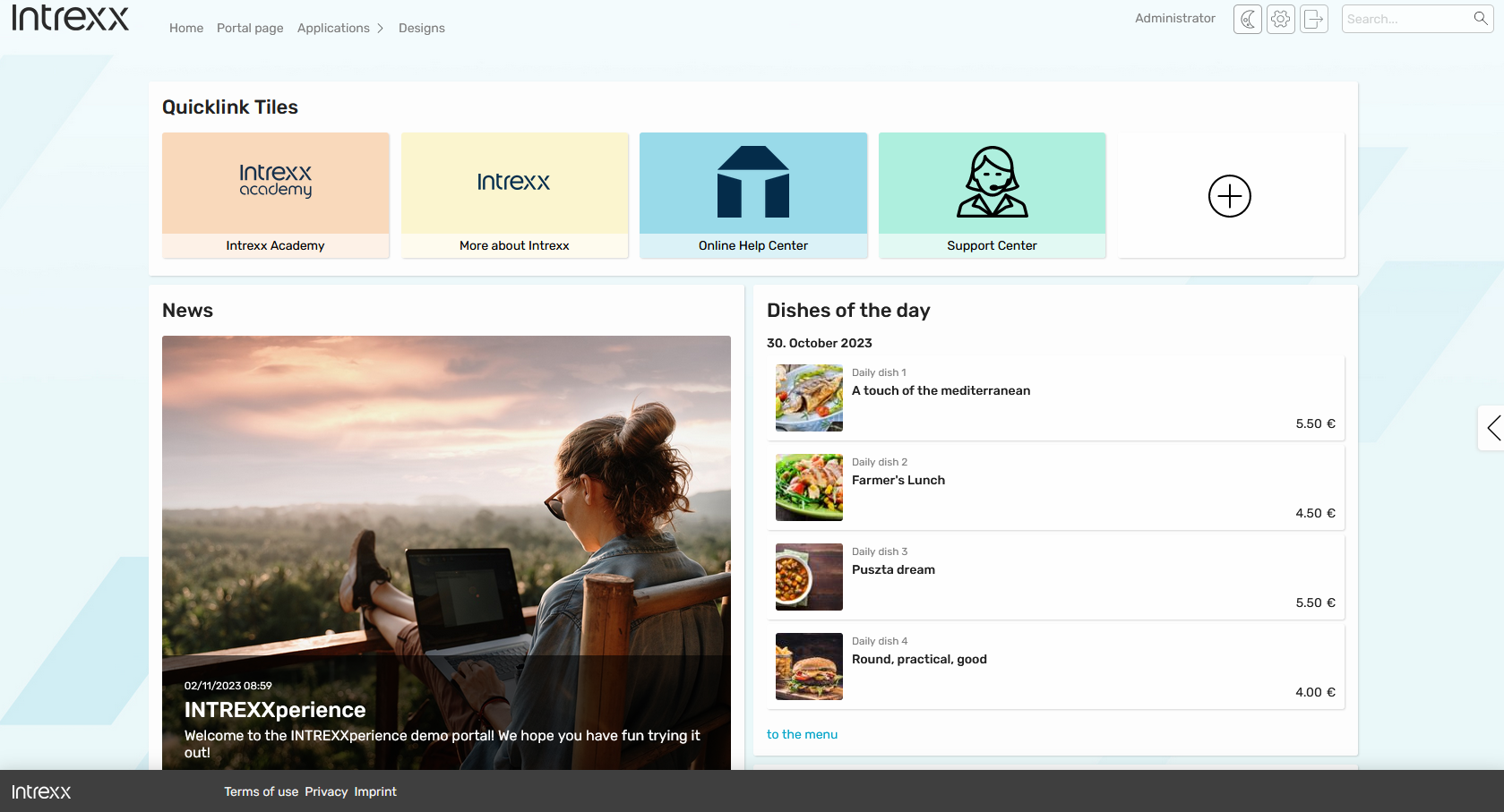
To make data from applications available on a portal page, portlets can be defined in all applications.
Portlets can also be displayed on application pages using the "Portlet Container" application element.
General information about portlets can be found here. Click here to learn how to embed portlets in a portal page.
To use a view page as a portlet, first create a view page containing the application elements that display the desired data. Be sure to take the size of the view page into account so that the portlet displaying it can be positioned appropriately based on its dimensions.
To make a view page available for a portlet, the "Use as portlet" setting must be enabled. You can find these in the Portal Manager, in the "Applications" module, within an open application, in two locations:
-
In the Properties dialog for view pages, on the "Portlet" tab
-
In the application properties, on the "Portlets" tab, when you click "Edit" next to "
 ."
."
The following conditions must be met for an application page to be used as a portlet:
-
There is no portlet container on the page.
-
This page is a view page (input pages cannot be used as portlets).
Define the portlet in the application properties
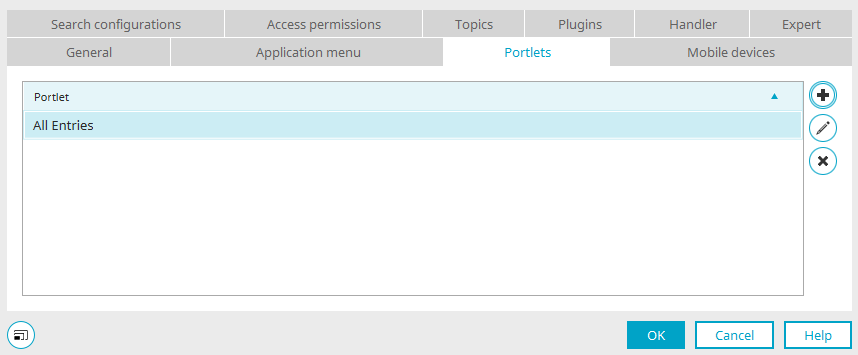
This section lists all view pages that are already being used as portlets. To use a new view page as a portlet, click "  " and then "Add Portlet."
Add a portlet
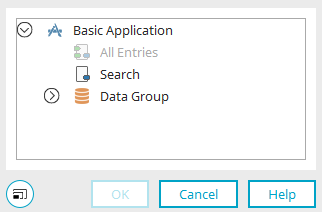
Select the desired view page here and click "OK" to save the setting and close the dialog box.
You will then be back in the application properties on the "Portlets" tab. Click "Edit Portlet" here at if you want to change the portlet's settings.
Edit Portlet
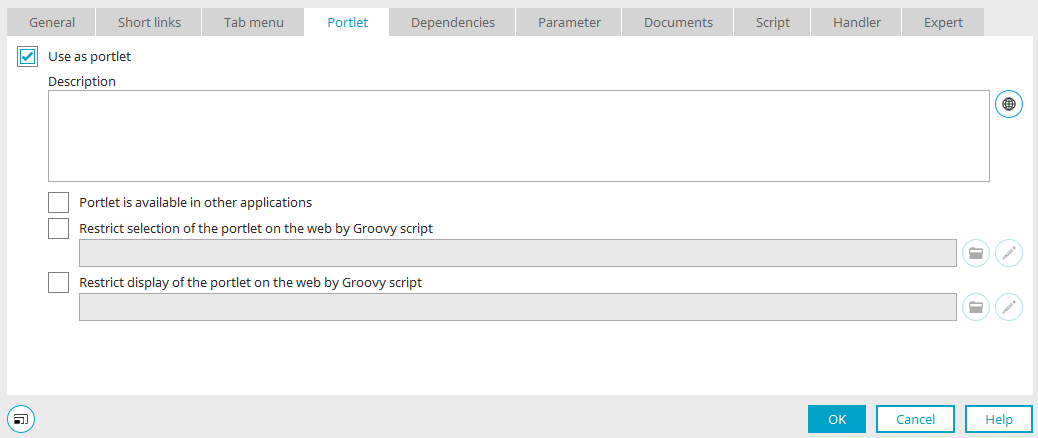
These settings are not available if there is a portlet container on the page.
Use as a portlet
This setting can be configured when you open the Properties dialog box for a view page. When the Application Properties dialog box opens, the setting is already configured and does not appear in the dialog box. If this setting is enabled, the view page is used as a portlet.
Description
You can enter a description of the portlet here.
 Multilingualism
Opens a dialog box where the description can be entered in the various portal languages.
Use the portlet in other applications as well
With this setting, the portlet can be integrated into other applications and on portal pages.
Restrict Portlet Selection on the Web Using a Groovy Script
If this setting is enabled, Groovy scripts can be used to control the portlet's selection in the browser.
Restricting the Portlet's Display on the Web Using a Groovy Script
If this setting is enabled, Groovy scripts can be used to control how the portlet is displayed in the browser.
 Select a script file
Each one opens a dialog box where you can select or create a Groovy file.
Edit Script
Opens the script editor in each case.
Groovy Script - Examples
You can find examples of how Groovy is used in this area here.
Click "OK" to save the settings and close the dialog box.
 Remove Portlet
Removes the currently selected view page from the list.
If a view page is defined as a portlet, you will find the portlet—provided you have the appropriate permissions—in your browser on all portal pages in the "Portlets from Applications" section, listed under the page title. This allows the portlet to be made available for use in a browser.
Portlet Container
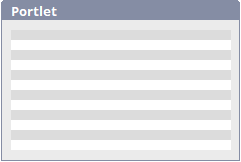
The portlet container is an application element that can be used to display portlets on view and input pages. Here, too—as on all portal pages—you'll find the arrow button on the right-hand side of the page in your browser; click it to access the settings and select and arrange the portlets you want. You can find more information about the portlet container here.