

Connector for Microsoft 365 and Teams
Whether it's Microsoft Teams, OneDrive, Excel, PowerPoint, or Word—these programs from the Microsoft ecosystem have become indispensable. With the Intrexx Connector for Microsoft 365 and Teams, you can build a strong bridge to these applications. This opens up entirely new possibilities for you to use Intrexx to boost efficiency in your company.
Thanks to the integration with Microsoft Teams, you can now send messages, create new channels, and schedule meetings directly from Intrexx. For example, you can easily manage projects and training sessions right from Intrexx: Participants can be automatically added to the appropriate Teams channel, or invitations—including a Teams link—can be sent directly from your applications.
You can also use the connector to link an Intrexx data field to Microsoft Drive. If a data field is linked to a file selection control, the files are uploaded directly to Microsoft Drive. You can view the files using the file view control or the view table. When you open files from within Intrexx, the document is displayed in Drive. For Office files (Word, PowerPoint, Excel), the editor opens directly in the web browser.
Using the new OneDrive control, your drives are displayed and managed in Intrexx in a tile or list view. You can view and download documents in Drive, and add new files. You can use custom permissions based on user roles to determine who can access which drives. This way, you can consolidate all your files and documents in one central location and eliminate siloed systems. This allows you to store, manage, and access all relevant documents for a project—for example, directly in Microsoft Drive—conveniently, without having to leave Intrexx. Whether you're saving documents from Intrexx to Microsoft 365, view documents from Microsoft 365 in Intrexx, or open or download Microsoft 365 documents directly from Intrexx using Microsoft’s online editing mode—with the connector for Microsoft 365 and Teams, you can manage your documents efficiently on a single platform.
"Connector for Microsoft Office 365" vs. "Connector for Microsoft 365 and Teams"
The Connector for Microsoft 365 and Teams replaces the Connector for Microsoft Office 365, which will no longer be supported starting in March 2023.
Connector for Microsoft 365 and Teams includes all the features of the Connector for Microsoft Office 365—and many more. If you're using the Office 365 Connector, you can request a free license for the Connector for Microsoft 365 and Teams.
To migrate your applications to the Connector for Microsoft 365 and Teams, you need to follow these steps:
-
Setting up registration with Intrexx. The app registration with Azure can still be used. However, the redirect URL must be adjusted. It may be necessary to expand the scopes and also create a web platform for using the OneDrive control included in the new connector.
-
Existing file fields that contain links to Drives must be recreated and reconfigured, and the corresponding fields in the controls must be replaced.
For detailed information about the Connector for Microsoft 365 and Teams, see the section Connector for Microsoft 365 and Teams
Connector for Microsoft 365 and Teams provides you with a range of features that enable Intrexx and Microsoft 365 to work together.
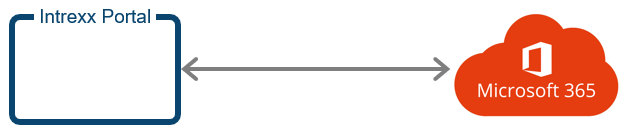
The focus here is on integrating Microsoft Teams features. In addition, there is a simple configuration for accessing Microsoft OneDrive and a separate data group or data field for Microsoft 365 files.
Teams
Among other things, you can send Teams messages to a (dynamic) group of recipients directly from your portal. The content of the messages can be dynamically generated from data records in Intrexx. Teams messages can also be sent on an event-driven basis. This way, team members can automatically receive a message when, for example, a machine triggers an event in Intrexx.
Communication can be bidirectional. This is how you can retrieve data from the Intrexx portal in Microsoft Teams. And vice versa, importing data from Microsoft Teams into Intrexx.
Start a chat, phone call, or video call with the click of a button
You can add buttons to portal pages that allow portal users to start a Teams chat or Teams call directly from the portal. This is launched directly from the Microsoft Teams portal. Both the Teams desktop app and the Teams web app can be used for this purpose.
This allows portal users to easily communicate with each other via Microsoft Teams.
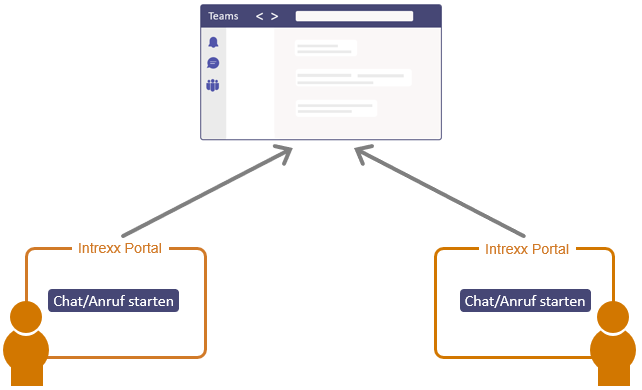
Portal users can also communicate directly from the portal via Microsoft Teams with any other person who has a Microsoft 365 account.
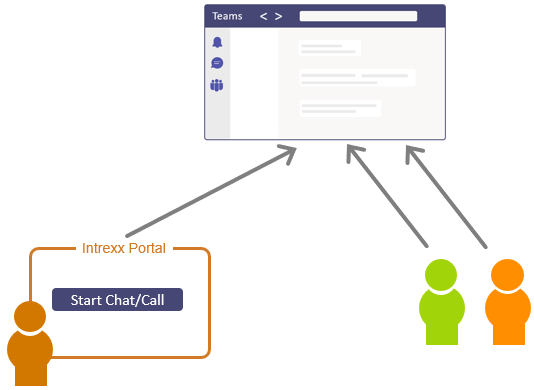
When launching the Microsoft Teams from the portal, participants can be "included" in the chat or call. You can access, among other things, static participant lists, participants from data groups, or participants from data fields. In other words, not only is Microsoft Teams called up, but you can also specify the communication participants at the same time.
For the functionality described above, communication between Intrexx and Teams takes place directly through the browser. Therefore, you do not need to register Connector for Microsoft 365 and Teams in the "Integration" module to start a Microsoft Teams chat or call. All you need to do is insert a button with the action type "Microsoft Teams Communication" on an application input page.
For detailed information on this topic, see the " Launch Microsoft Teams Communication from an Application" chapter.
Create a team or channel
You can use Intrexx processes to automatically create new teams and channels in Microsoft Teams. Intrexx accesses Microsoft Teams using a service account. For example, in Intrexx, you can see which teams already exist in Microsoft Teams and select which channel you want to assign to that team.
For detailed information on this topic, see the " Create Team/Channel Action" section
Create and send messages in channels or chats
You can create and send Teams messages or chats. You can specify, among other things, whether to send static, recurring message texts or dynamic texts. For example, you can generate messages from system values or Velocity.
For detailed information on this, see the " Teams Message Action" section.
Create Meetings
You can create " Microsoft Teams" meetings. Among other options, you can choose between static participants and dynamic participants. For example, you can generate dynamic participants from a query on a data group.
For detailed information on this, see the " Create a Teams meeting" section
OneDrive
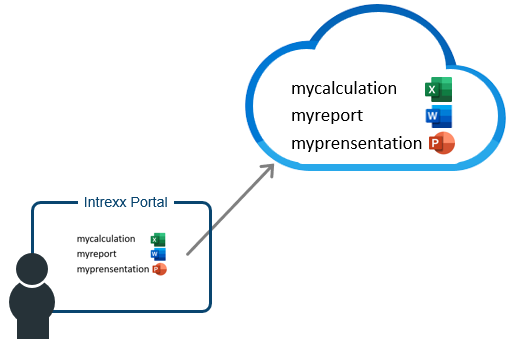
Using the " Connector for Microsoft 365 and Teams " (Portal Settings), you can configure, among other things, whether portal users must log in to Microsoft 365 when accessing Microsoft OneDrive, or whether they are automatically logged in to Microsoft 365 via Intrexx.
For more information on the " Microsoft OneDrive" features, see the following sections:
MS365 File Data Field and MS365 Data Group
You can link Intrexx records to Microsoft 365 files. You can do this by adding the "MS365 File" data field to an existing data group or by creating an "MS365 Data Group."
Existing data group
You can add an "MS365 File" data field to a (regular) data group. This option is useful, for example, if you are already using a data group in an application and want to set up a link to " Microsoft 365" records there. When creating the "MS365 File" data field, Intrexx opens a Properties dialog that prompts you to enter all the necessary information for connecting to Microsoft 365.
New data group
Intrexx now includes a new data group type called "MS365 Data Group." It (automatically) contains the "MS365 File" data field. When creating an "MS365 Data Group"—just as when adding an "MS365 File" data field—a Properties dialog box appears, prompting you to enter all the necessary information for connecting to Microsoft 365.
So, for example, if you're creating a new application that will incorporate Microsoft 365 files, it makes sense to create a new "MS365 data group."
Example - Add an "MS365 file"
They carry out projects in which one or more documents are created and managed for each project. Please save the documents at Microsoft OneDrive.
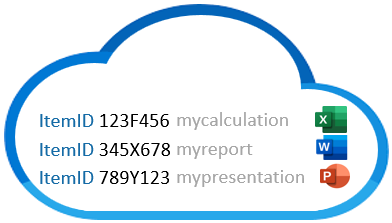
In the Intrexx portal, portal users should be able to (for example) add Microsoft 365 files to projects in a table view and then open and edit them.
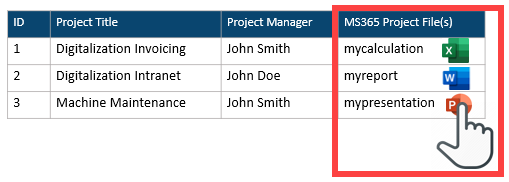
In the corresponding Intrexx application, you have created a data group containing the necessary information for each project. You can now add the "MS365 File" data field to the data group you have already created. In doing so, Intrexx automatically creates the "ItemID" data field. When you add the "MS365 File" data field, Intrexx prompts you for the information needed to establish a connection to Microsoft OneDrive. When uploading a file from the Intrexx portal, Intrexx automatically determines the document's item ID and stores it in the data field of the same name within the data group. This establishes the link between the Intrexx record and the document at Microsoft OneDrive. By default, the ItemID data field is hidden in the portal.
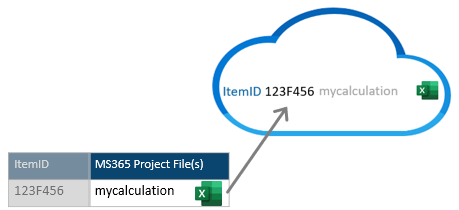
Simple configuration
Linking Microsoft 365 files to Intrexx records was also possible in earlier versions of Intrexx.
It is now even faster and easier to link files. For example, this reduces the number of steps required, and the necessary fields—such as the item ID for the " Microsoft 365" document—are created automatically. In addition, Intrexx identifies the directories that exist on Microsoft OneDrive and automatically saves the item IDs in the corresponding field of the data group. Therefore, you no longer need the Microsoft Graph API to determine the IDs of the Microsoft 365 objects.
For more information on the MS365 file data fields and MS365 data group features, see the following sections: