

Data Transfer - Data Source/Destination "Text File"
Here you will find instructions for configuring a data transfer if, in the first step of creating the connection, you selected "Text file" as the data source or data destination type. Here you will find the requirements for using text files in a data transfer.
Source / Destination - Text File
Clicking "Search" at  opens a dialog box where you can select the source file or the destination path for the export file. The file must be located in a directory that has been shared with the server.
Column separator
Select the character used to separate the columns in the text file here.
Field Delimiter
Select the character here that marks the beginning and end of each entry in the text file.
File contains a header
In this case, the first row is not imported, but is used as a column header during field mapping.
Encoding
Here you can select the encoding used in the text file.
Time Zone
The time zone can be changed here if the text file contains date values.
Click "Next."
Source / Destination - Text File
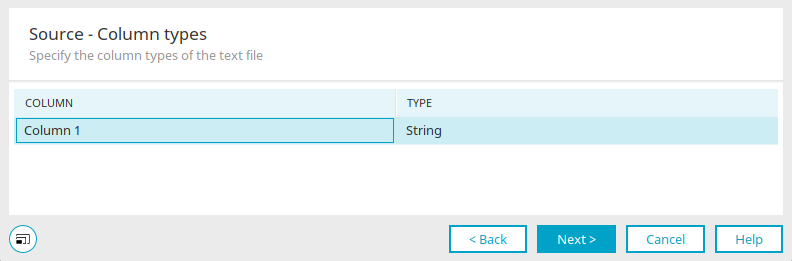
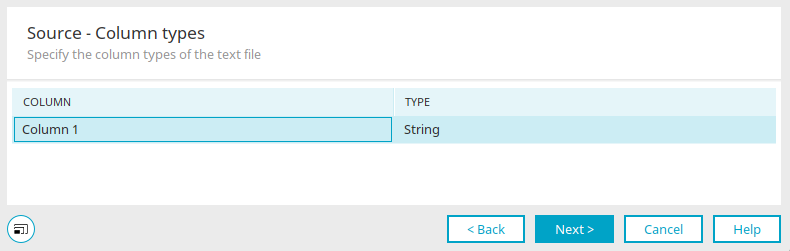
The column names and data types from the source file are displayed here. The data types can also be changed here. Clicking a cell in the "Data Type" column displays a drop-down list of data types.
Click "Next" to complete the configuration.
Requirements
Text files used as the source or destination in a data transfer must be in the following format:
-
The first line must contain the names of the data fields, separated by semicolons
-
There must be no semicolon at the end of the line. By definition in schema.ini, the semicolon can be replaced with any delimiter.
-
The data is listed in the following lines. The order of the fields must match that of the first row.
If you want to export data from Intrexx to a text file, you must first create a configuration file. You can create the configuration file in ANSI format using a text editor, such as Notepad. Name the file "schema.ini." For each file in this directory, create a section that describes the properties of the text file as follows:
[table.txt]
ColNameHeader=True
Format=Delimited(;)
MaxScanRows=25
CharacterSet=ANSI
Col1=Feld1 Char
Col2=Feld2 Integer
Col3=Feld3 Float
Line 1: File name in square brackets (required)
Row 2: Column headers present (True) or absent (False) (required)
Line 3: Delimiter (required)
Line 4: Number of lines read to determine the data type of the fields
Line 5: Character set
Lines 6 through 8: Names and data types of the individual columns. Permitted values are
-
Bit
-
Byte
-
Char
-
Currency
-
Date
-
Float
-
Integer
-
Longchar
-
Short
-
Single
For date data types, use the following formats
-
dd-mmm-yy
-
mm-dd-yy
-
mm-dd-yy
-
yyyy-mm-dd
-
yyyy-mm-dd
Here, "mm" refers to the month as a number, and "mmm" refers to the month's name. A field that contains only numbers with leading zeros and is to be imported into Intrexx with those zeros must be defined as a "Char" type. When importing from a text file (*.txt, *.csv) into an Intrexx application via the OLEDB interface, leading zeros from a field containing only digits are not imported, even if the corresponding target field in the application has the "String" data type. Intrexx has no control over this behavior of the OLEDB interface. The interface automatically treats fields that contain only digits as integer fields, unless there is a configuration file named schema.ini in the same directory as the text file that defines the data type.
You can find more information here.
Transformation - Field Selection
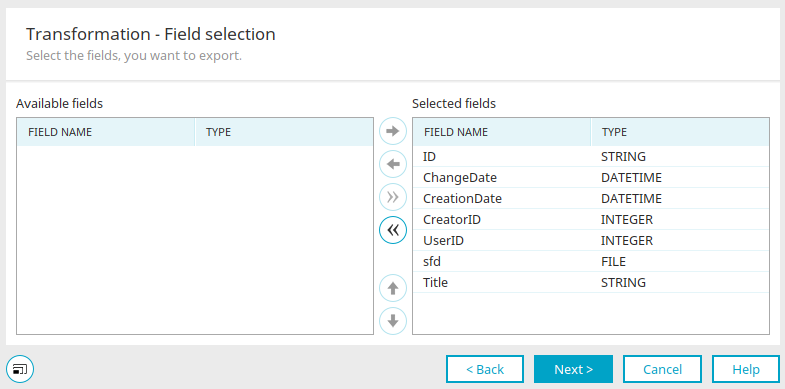
If you have selected "Text File" as the destination in the data transfer configuration, the "Transformation - Field Selection" dialog box will appear. You can find all the information about this dialog here.