

Requirements
To set up the Intrexx Connector for SharePoint Server/Online, you should have the following information on hand:
Microsoft Azure
-
Directory ID (client); TenantID
-
Application ID (Client)
-
Secret client key (value!)
Microsoft SharePoint
-
Name of the SharePoint page
-
Name of the SharePoint list
-
Name of the SharePoint document library
-
Tenant Name
You will also need the following information:
-
Root URI (e.g., https://login.microsoftonline.com)
To create a data group, you'll need the following information from SharePoint:
-
(Internal/technical) field names and data types of the fields you want to access.
Step-by-Step
To create the Intrexx " Connector for SharePoint Server/Online," follow these steps:
-
Launch the "Integration" module.
-
Under "Consume Data," select "Connector for Connector API."
-
Right-click.
-
Select "+ New Data Source."
The "General" dialog box appears.
General Information
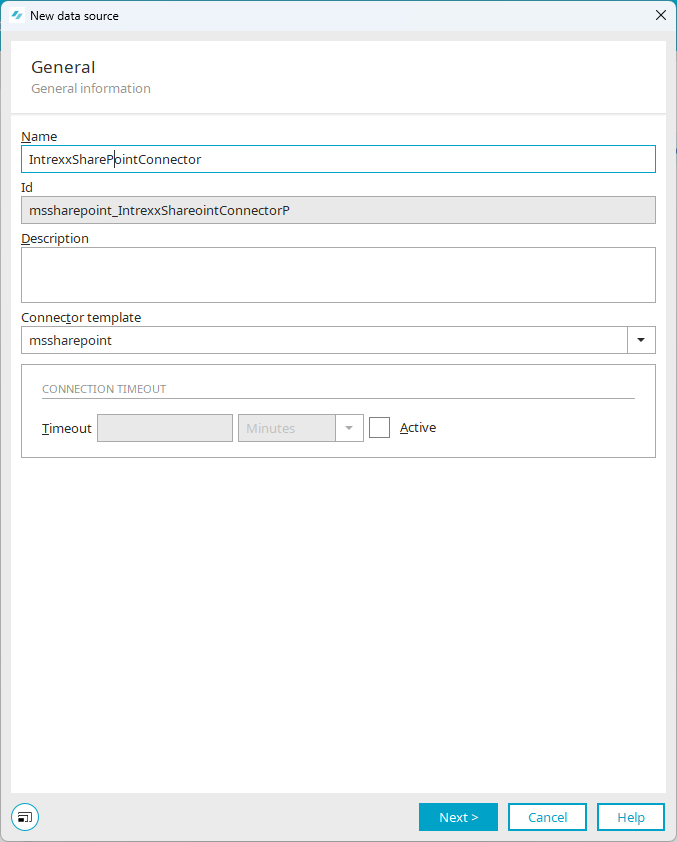
Name
Enter the name of the connection here. The name may only contain the letters [a-zA-Z] and numbers [0-9], as well as underscores and hyphens.
Displays the ID of the connector or connection. This is automatically generated from the connector template and the connector's name, separated by an underscore.
Description
You can enter a description of the connector here.
Connector Template
Select "mssharepoint" here.
Timeout
Here, you can enter the number of milliseconds, seconds, minutes, or hours for the timeout. Select the time unit from the drop-down list to the right of the timeout field.
Active
If you set this option, the timeout settings are enabled.
-
Click "Next."
This will take you to the "Data Groups" dialog box.
Data Groups
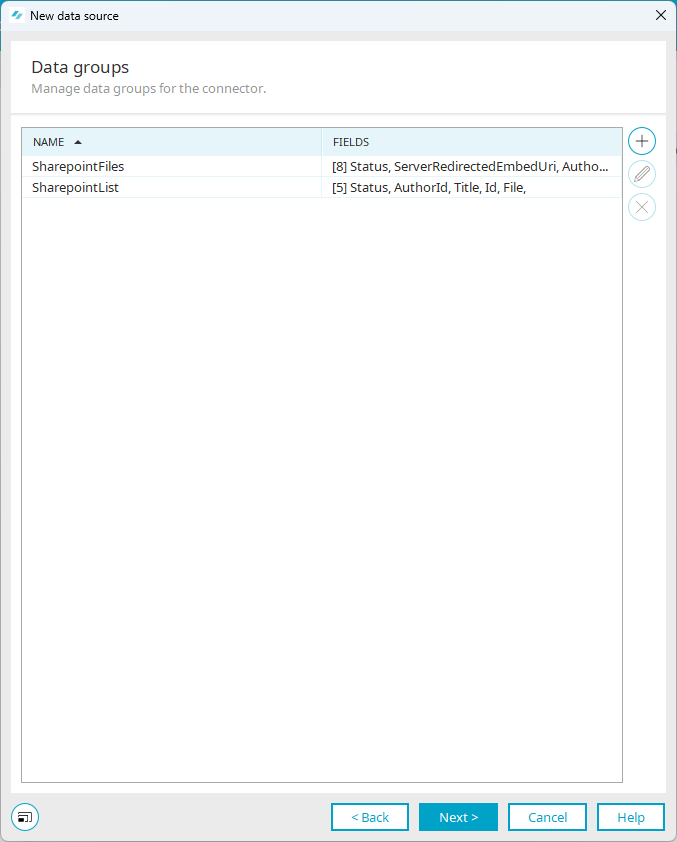
The data groups "SharepointFiles" and "SharepointList" have already been created. They serve as templates or examples. They contain information you'll need when creating your own data groups or additional ones.
At this point, you can choose not to create a data group and do so after creating the Connector for SharePoint Server/Online.
For detailed information on creating a data group, see the section " Create a data group in the " Connector for SharePoint Server/Online "."
-
Click "Next."
This will take you to the "Authentication" dialog box.
-
Under "Authentication Type," select "OAUTH2."
The fields containing the required information for "OAUTH2" are displayed.
Authentication
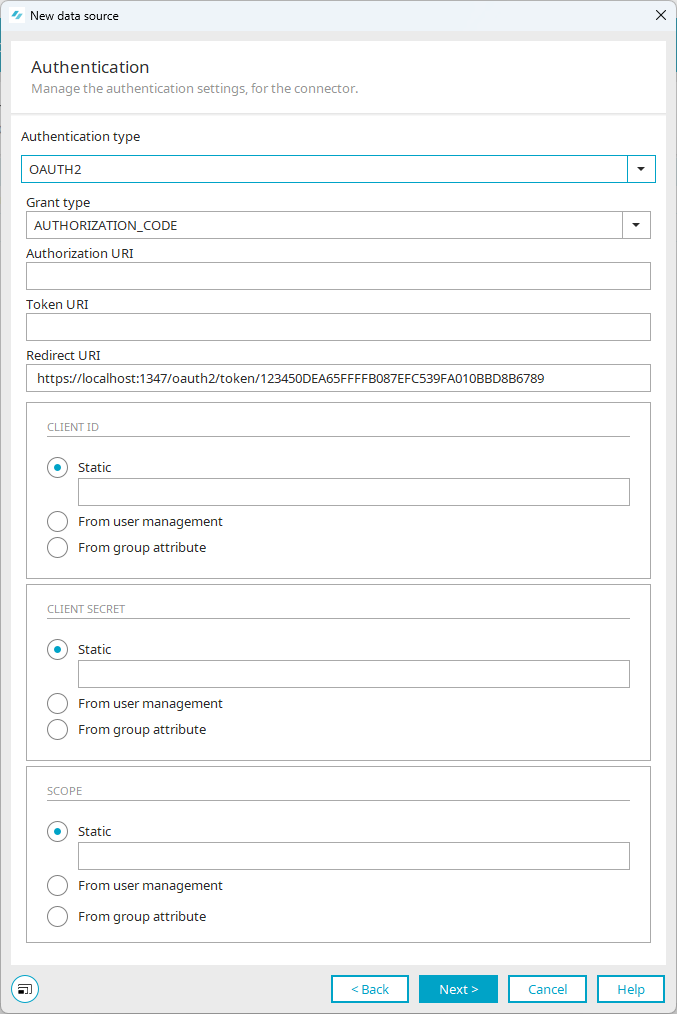
Authentication Type
Select "OAUTH2" here.
Grant Type
Select "AUTHORIZATION_CODE" here.
Authorization URI
Enter the authorization URI here.
The authorization URI is structured as follows:
<https://login.microsoftonline.com>/[TenantID]/oauth2/v2.0/authorize
Example
https://login.microsoftonline.com/1234e7e16-b7ee-41a3-ffff-76d9716789/oauth2/v2.0/authorize
Token URI
Enter the token URI here.
The token URI is composed as follows:
<https://login.microsoftonline.com>/[TenantID]/oauth2/v2.0/token
Example
https://login.microsoftonline.com/12345-e16-b7ee-ffff-ak05-76d971-6789/oauth2/v2.0/token
Redirect URI
Here, the redirect URI is set automatically by Intrexx.
The redirect URI is composed as follows:
<BaseURL>/oauth2/token/<SharePoint Connector GUID>
Example:
https://exampleportal.com/service/oauth2/token/123450DEA65FFFFB087EFC539FA010BBD8B6789
Base URL You can find the base URL in the main menu under "Portal > Portal Properties > Frontend Web Server."

GUID of the Connector for SharePoint Server/Online If necessary, you can determine the GUID of the Connector for SharePoint Server/Online yourself. For a detailed description of this, see the section " Connector for SharePoint Server/Online Determine the GUID (optional)."
You must configure the redirect URI in Azure within the IntrexxPortal app. For a description of this, see the section " Configure the Redirect URI in Microsoft Azure."
Client ID
Static: Enter the application ID from the IntrexxPortalApp that you registered in Microsoft Azure.
Client Secret
Static: Enter the value (!) of the secret client key from the IntrexxPortalApp that you registered in Microsoft Azure.
Scope
Here, you define the permissions that Intrexx users or Intrexx service accounts should have to access SharePoint.
Static: You can enter a default value here. Intrexx users or Intrexx service accounts will then access SharePoint using the permissions you have granted in Microsoft Azure.
If you want to use the default value, you must enter the following:
https://<TenantName>.sharepoint.com/.default
Example
https://examplecompany.sharepoint.com/.default
You can also specify the permissions you have granted in Microsoft Azure individually. The individual permissions must be separated by a space.
For more information about permissions related to the Connector for SharePoint Server/Online, see the section " Set API Permissions for Intrexx Connector for SharePoint Server/Online"
-
Click "Next."
This takes you to the "Service User" dialog box.
User Services
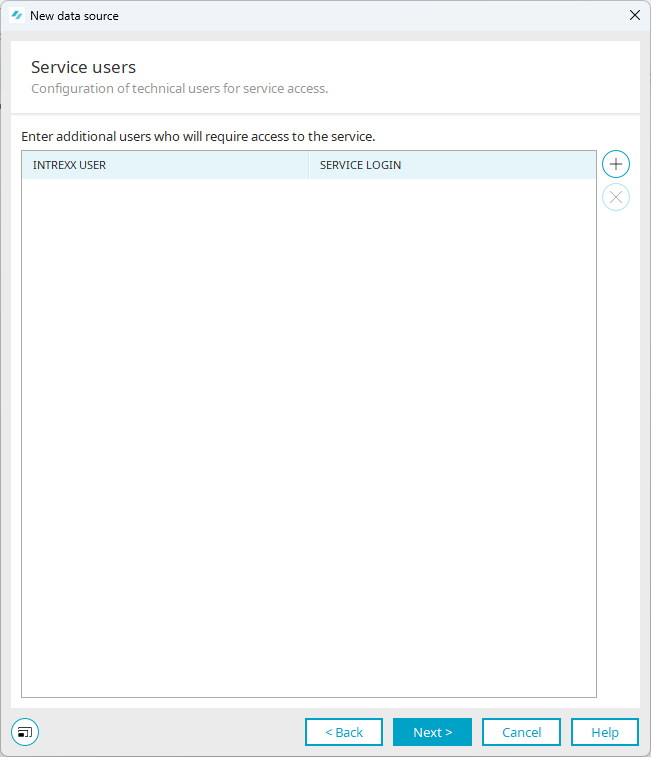
Service accounts allow users to sign in to SharePoint without using a personal user account. A service user is useful, for example, when processes need to log in to SharePoint automatically. It is also possible to configure a third-party data group so that users log in to SharePoint using a service account.
For detailed information on creating and using service users, see the following sections:
-
Click "Next."
This will take you to the "Expert Settings" dialog box.
Expert Settings

Here you will find the following information:
Attribute Value connector.auth.type OAUTH2 oauth2.accessTokenUri https://login.microsoftonline.com/12345e16-b7ee-41a3-ffff-76d971cc6789/oauth2/v2.0/token oauth2.authenticationScheme header oauth2.clientAuthenticationScheme client_secret_basic oauth2.clientId 1234d5b1-9654-4275-ffff-34ec7ec06789 oauth2.clientId.source STATIC oauth2.clientSecret 1234~xVQ40j8VZV_ffff_pH2uR.aHtt56789 oauth2.clientSecret.source STATIC oauth2.grantType authorization_code oauth2.redirectUri https://exampleportal.com/service/oauth2/token/123435B47B25411A82E7ADA2D6C620FDDD56789 oauth2.scope https://example.sharepoint.com/.default oauth2.scope.source STATIC oauth2.userAuthorizationUri https://login.microsoftonline.com/12345e16-b7ee-ffff-ad05-76d971c6789/oauth2/v2.0/authorize serviceTimeout 0 Once the connector is complete, additional attributes will be displayed.
-
Click "Finish."
The connector is displayed.

-
Open the connector.
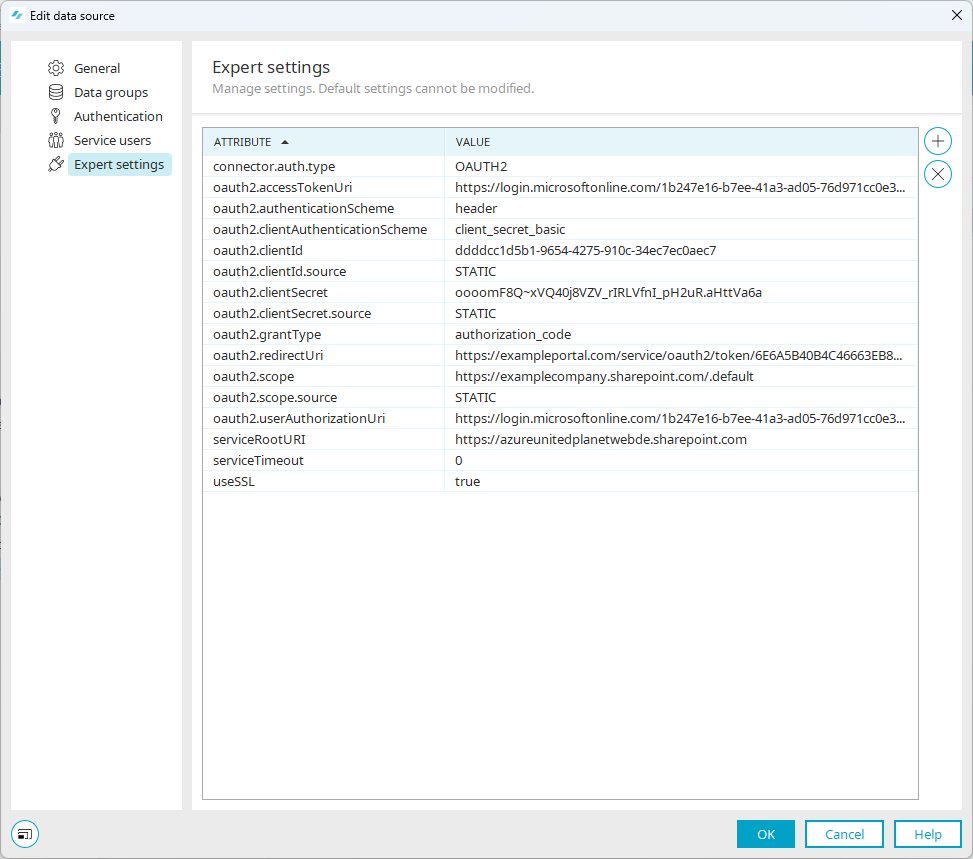
Additional expert settings are displayed.
-
Enter the appropriate value for the "serviceRootURI" attribute.
Attribute Value serviceRootURI https://[TenantName].sharepoint.com
The "serviceRootURI" attribute must contain the full URL of the SharePoint site.
useSSL true
Your Next Steps
Create a data group in the " Connector for SharePoint Server/Online " (if you haven't already done so)