

Grouping
A group allows you to combine multiple elements—for example, to limit their space on the page, group them visually, or move them together.
The "Grouping" application element is one of the basic controls.
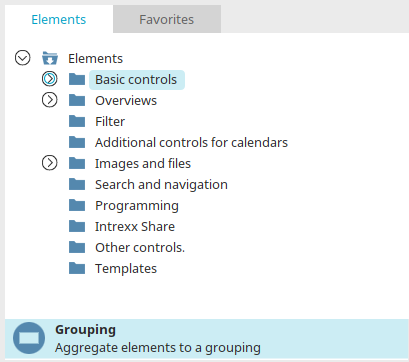
You can find the element in the "Applications" module under "Elements. " You can create a new group by dragging and dropping the element from here onto the workspace.
For more information on creating elements, click here.
Once you've created a group, you can easily add the desired items to the group using drag-and-drop, and they will be grouped together. You can then move the group, including the elements it contains, to the workspace using drag-and-drop.
You can open the grouping's Properties dialog box by double-clicking the grouping. Be careful not to click on an element that is already included, because doing so will open that element's Properties dialog rather than the Properties dialog for the group.
General
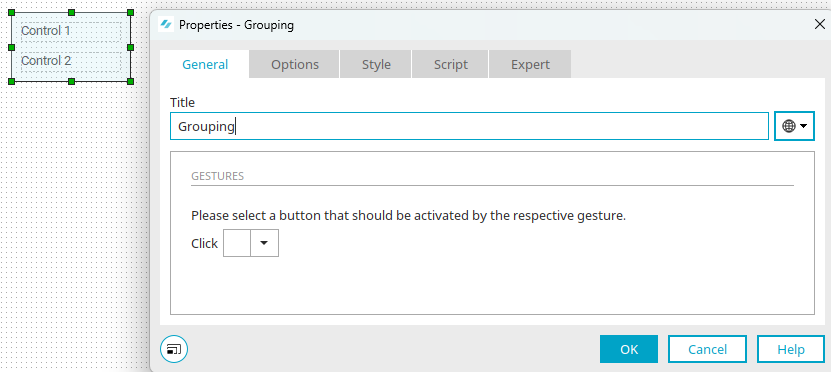
On the "General" tab in the grouping properties dialog box, enter the desired title. You can find information about multilingual titles here.
If the group contains buttons, you can specify here which of the buttons should be triggered by a tap on mobile devices.
Options
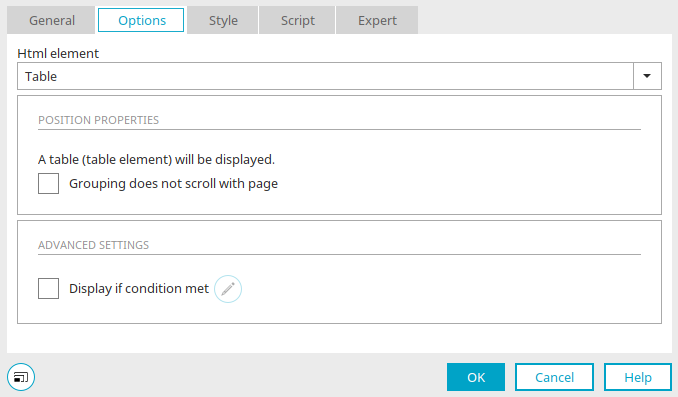
The following HTML elements can be selected here for grouping:
Div
In HTML, the <div> element is used. Each line becomes a container.
Heading
In HTML, the heading elements <h1> through <h6> are used. Only inline elements are allowed as the content of the grouping. You can select the heading level.
Inline elements are elements that do not create additional line breaks around them, such as <strong> or <span>.
Unordered List
The grouping is implemented as an unordered list containing the elements <ul> and <li>, with the elements within the grouping displayed as list items.
Ordered List
The grouping is implemented as an ordered list containing the elements <ol> and <li>, with the elements within the grouping displayed as list items.
Paragraph
The elements contained in the group are displayed in sections using the <p> element. Only inline elements are allowed as the content of the grouping. A <br> element is inserted between the lines to create a line break.
Preformatted Text
In HTML, preformatted text is represented using the <pre> element. Only inline elements are allowed as content. The <img> element is also not allowed.
Table
The <TABLE> element in the page's HTML is used for grouping. Elements included in the grouping are each displayed in their own cell. You can use a setting to choose whether the grouping moves with the page when you scroll or not.
Fieldset
The `fieldset` element groups elements within a form. This option allows you to choose whether or not to display the grouping title. The title is implemented as a LEGEND element. Each line becomes a container (div element).
Conditional Display
You can find all the information on this topic here.