

FileWalker
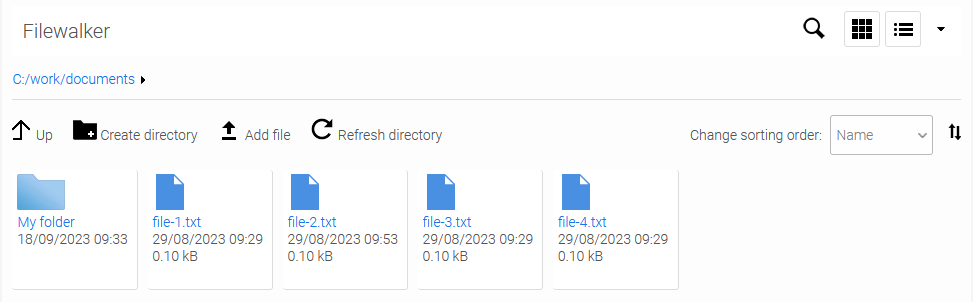
This element allows you to access files on the network. This requires an established connection and sufficient permissions.
The "FileWalker" element is one of the basic controls. This element can be used to structure a page and has no other special properties.

You can find the FileWalker element in the "Applications" module under "Elements. " You can create a new element by dragging and dropping it from here onto the workspace.
When you create the element, the Properties dialog box opens automatically.
Settings
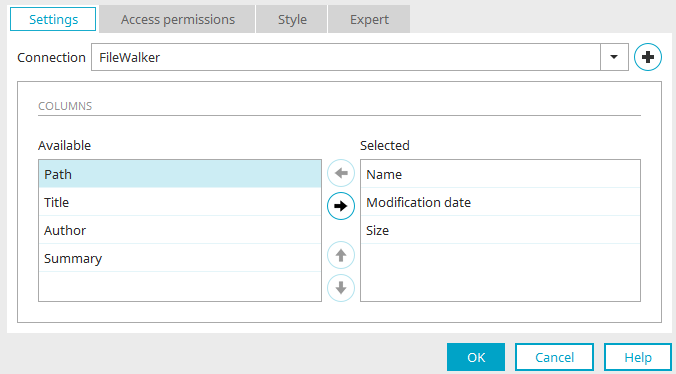
Select the connection you want here.
 New
New
Opens a dialog box where you can configure a new connection.
Under "Available," you'll find all the file attributes that can be displayed in the FileWalker list. The file attributes listed under "Selected" are displayed in the FileWalker list.

 Move entries horizontally
Use the arrow buttons to move the desired file attributes from one list to the other.

 Move entries vertically
You can use these arrow buttons to change the order in which the file attributes are displayed.
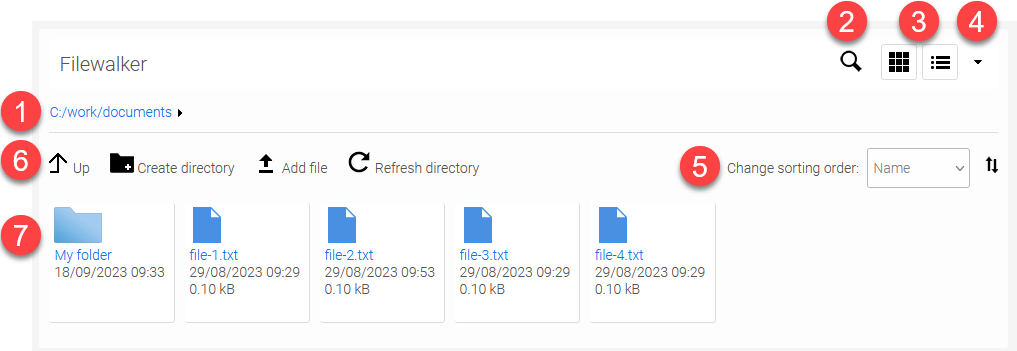
In the browser, FileWalker displays all the files and folders located in the connected directory.
1. Path
Here is the path whose files are displayed in FileWalker. If you create additional subfolders, you can navigate through the folder structure using the path.
2. Search for "  "
"
You'll find this button on the right side of the title bar. Clicking on it will display a search field where you can search for files and subdirectories.
3.  Block /
  List
List
The "Block" setting displays the file list in tiles. The "List" setting displays the file list in a table format.
4.  Displayed Fields
Displays a tooltip where you can select which fields should be shown in the file list.
5. Manage Folders
 Up
Up
Navigates to the parent directory.
 Create a folder
Opens a tooltip where you can create a new folder.
 Add File
Opens a tooltip where you can select and upload a file.
 Refresh Folder
Refreshes the contents of the currently open folder.
5. Change the sort order in 
Changes the sort order to ascending or descending.
Clicking on a filename opens the file; the program used to view it depends on the file type.
 File Options
When you hover over an individual file, the "File Options" button appears to the right of the file; when you hover over a folder, the "Folder Options" button appears to the right of the folder.
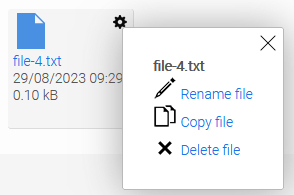
It opens a tooltip with additional functions.
 Rename File
Opens a tooltip where you can change the file name.
 Copy File
Creates a copy of the currently selected file and opens a tooltip where you can edit the file name of the copy.
 Delete File
Deletes the currently selected file.
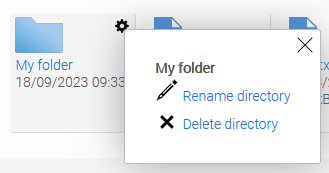
For folders, the button also appears when the mouse hovers over them.
 Rename Folder
Opens a tooltip where you can change the folder name.
 Delete Folder
Deletes the currently selected folder.
Setting "control.fileWalker.availableColumns"
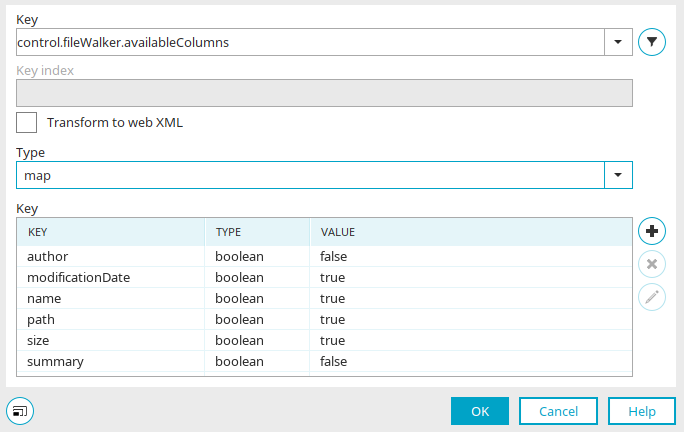
By default, all of a file's metadata is always loaded on the server side, regardless of whether it is needed or not.
To improve performance, the columns that should be selected by default can be defined using the "control.fileWalker.availableColumns" setting. This ensures that only the relevant data is loaded. When loading the page, the required columns are included in the request, since they can also be configured on the web.
This setting has no effect if de.uplanet.lucy.server.filewalker.noDocumentMetaData=true is set.
You can find general information on "Settings" here.