

Execution Date
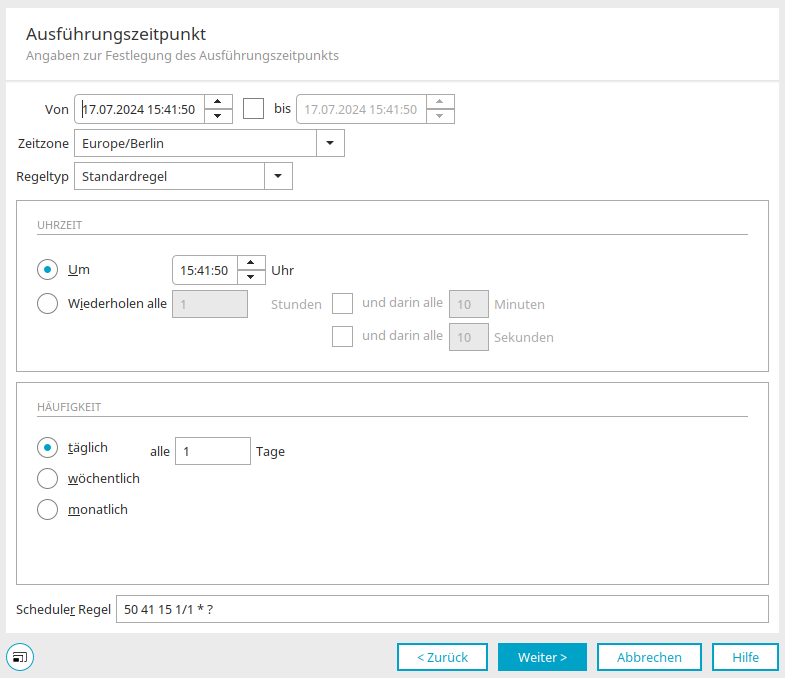
You can find this dialog, where you can set the time for automatic execution, in various places in Intrexx, such as in the properties of process elements
From / To
Enter the start and end dates here to specify the time period during which the task should run automatically. This setting is not available for timer actions.
Time Zone
Selecting a time zone determines which time zone the time specified in the dialog box refers to.
Rule Type "Standard Rule"
With the "Standard Rule" rule type, you can specify the time and frequency of when the rule is executed. The scheduler rule at the bottom of the dialog box is updated automatically.
Time
If "Standard Rule" is selected as the rule type, you can define the time for execution here.
To
This option allows you to set a specific time at which the task will run.
Repeat All
Specify here how many hours, minutes, or seconds should elapse before the action is repeated. The first time, the task will be scheduled to run at the next full hour starting from the value entered in the "From" field. If this is not desired, a custom rule can be configured.
Frequency
every ... days
For this option, enter the number of days after which the action should be repeated.
weekly
Select the day or days of the week here on which the job should be run.
monthly every ... months
For this option, enter the number of months after which the task should be repeated. In addition, you must specify on which day the execution should be repeated. The date can be specified as a number (first, second, third day, etc.) or as a day of the week (first Monday of the month, second Saturday of the month, etc.). If this information is not provided, the job will not run.
Scheduler Rule
Here, the settings you have configured are automatically formulated and entered as a scheduler rule.
Rule Type: "Custom Rule"
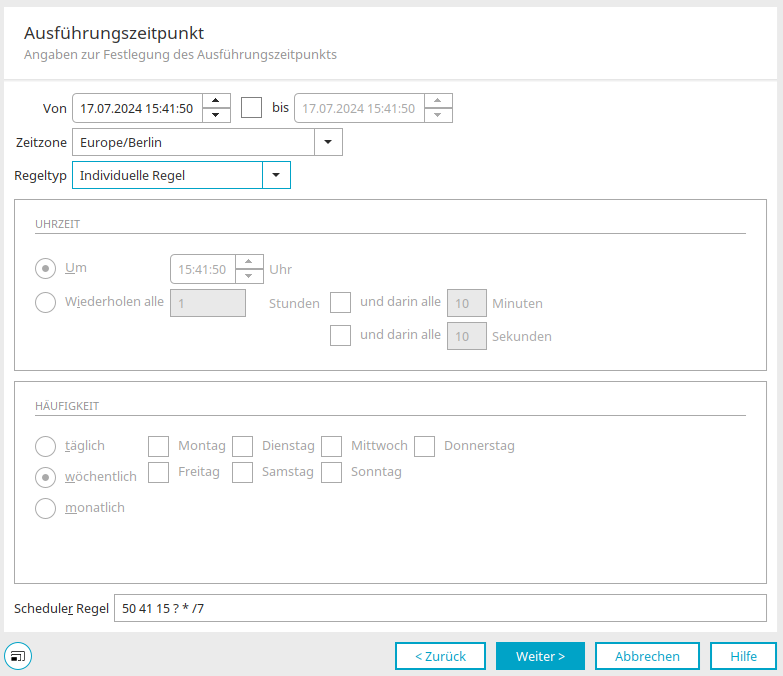
Scheduler Rule
You can enter a scheduler rule manually here. You can find information about the structure of the rules here. You can find a detailed description of CronTrigger expressions here (CronTrigger class).
Rule Type: "Multiple Individual Rules"
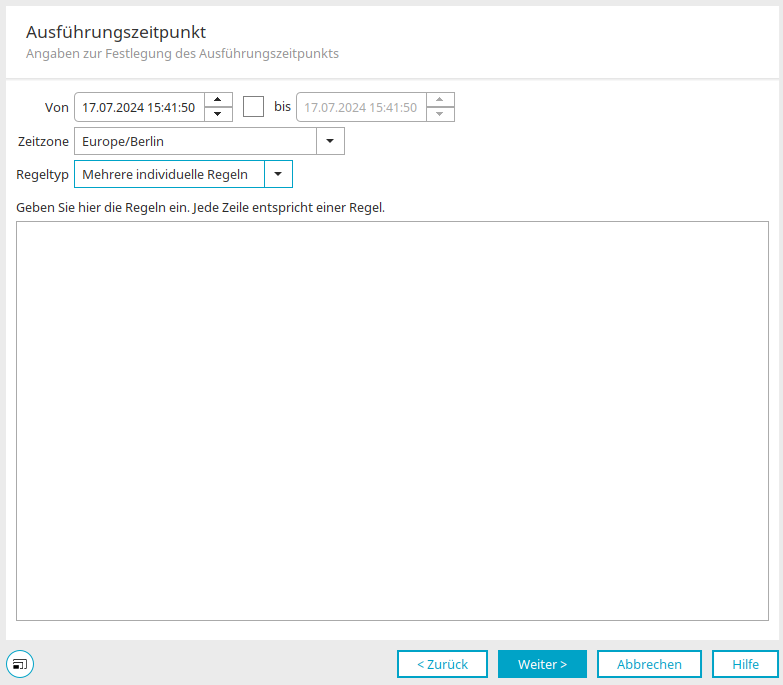
Here, you can enter more complex rules in a text field. A separate line should be used in the text field for each rule. You can find information about the structure of the rules here. You can find a detailed description of CronTrigger expressions here (CronTrigger class).
Rule Type: "Dynamically Determined Rule"
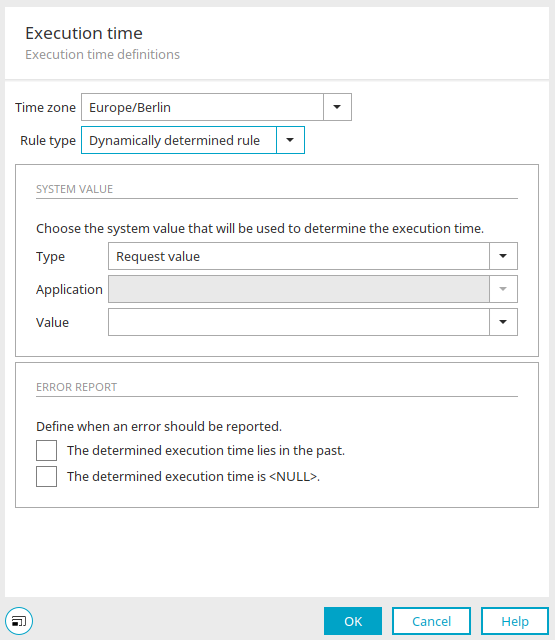
This setting can be selected for timer actions. With a dynamically determined rule, system values can be used to determine the execution time for a process.
System Value
The following system values are available:
-
Request Value
-
Session value
-
System Data Group
-
User Rating
Application
For the "System Data Group" system value, you can select the application in which the system data group is located.
Value
This is where you enter
-
For a request value: Name of the request variable
-
For a session value: Name of the session variable
-
for a value from the processing context: variable name
-
For a system data group value: Application and name of the data group
-
For a user value: User property
Error message
Use this setting to specify when an error should be logged.
The calculated execution time is in the past
Set this option to display an error message if the date has already passed.
The calculated execution time is <zero>
Set this option to display an error message if the value provided is NULL.