

Email Service
Intrexx allows you to send emails automatically. There are two ways to trigger the sending of an email:
-
When you click a button that has been configured accordingly
-
In processes with the corresponding process elements
The basic requirement for sending emails is to configure the email service in the "Tools" module. So, first set up the email service, test it, and activate it.
You can find all the information you need about configuring buttons in email-sending applications here.
You can find all the information about automatically sending emails in processes here.
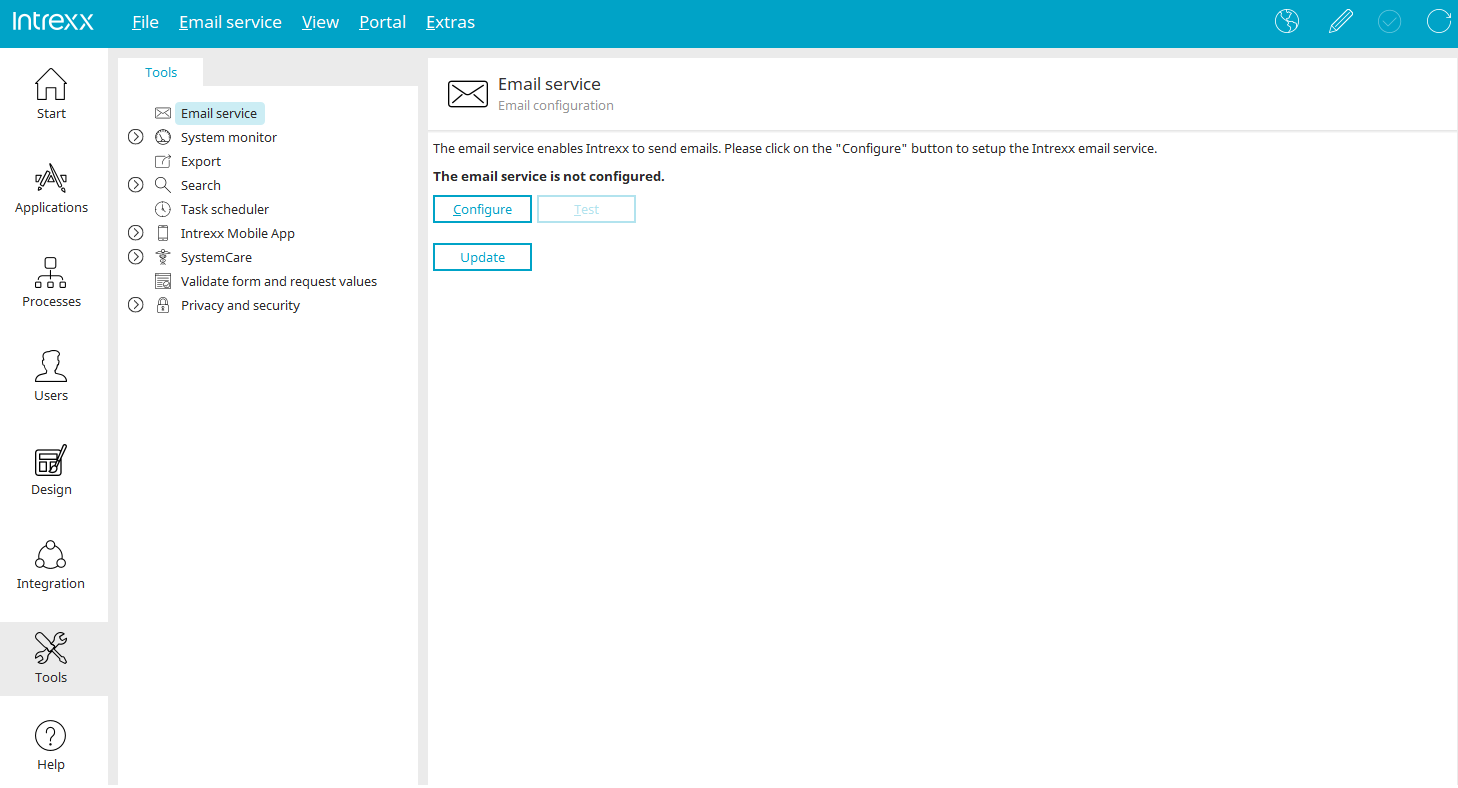
Configure
Clicking this button opens a wizard where you can set up the service.
Default Sender
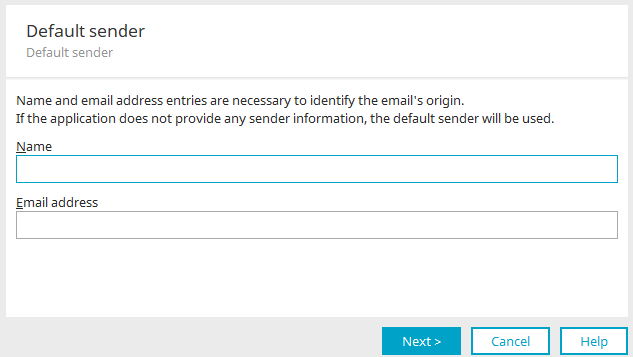
Name
Enter the name of the default sender here. The default sender is used when no specific sender has been defined in an application or process.
Enter the email address of the default sender here.
Click "Next."
Email Server
Up to Intrexx version 12.1.0:
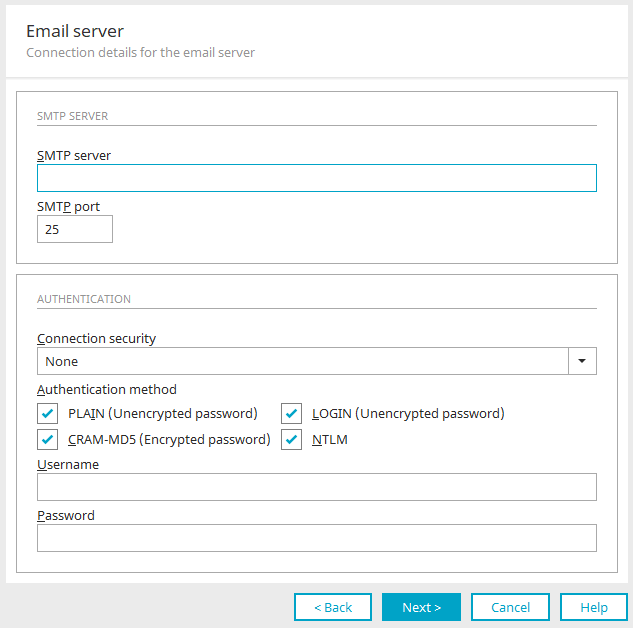
SMTP Server / SMTP Port
Enter the name or IP address of the SMTP server here.
The default port is 25. If you have any questions, please contact your system administrator. The mail server used does not necessarily have to be located on the Intrexx Portal Server's local network.
Authentication
The settings in this section depend on the settings required by your mail server.
Connection Reliability
For connection security, you can select "None," "STARTTLS," or "SSL/TLS."
Authentication Methods
Here you can specify how passwords are transmitted.
PLAIN
Transmits the password in plain text without encryption.
Login
Retrieves the password in plain text from the user's input on the device.
CRAM-MD5
Encrypts the password using the CRAM-MD5 algorithm.
NTLM
Authentication is performed using NTLM.
Username / Password
Enter your username and password here.
Click "Next."
Starting with Intrexx version 12.1.0:
OAuth2 Authentication for Exchange Online

Starting with Intrexx version 12.1.0, you'll find the "Type" drop-down list here. This allows you to select OAuth2 authentication for Exchange Online instead of the default authentication.
Preparation for Microsoft Entra ID
To set up OAuth2 authentication for Exchange Online in Intrexx, follow these steps:
1. Register a new app at https://entra.microsoft.com/#view/Microsoft_AAD_RegisteredApps/ApplicationsListBlade/quickStartType.

2. Select "New Registration."

3. Enter a name of your choice for the application. The name must not contain any spaces.
4. For the supported account types, select the "Only accounts in this organizational directory" option.
5. Click "Register."
API Permissions

1. Click "API Permissions" in the menu on the left.

2. Click "Add Permissions" here.

3. Select the "APIs used by my organization" option here.
4. Type "Office 365 Exchange Online" into the search box.

5. Under "App Permissions," search for "SMTP.SendAsApp" in the search field.
6. Enable the "SMTP.SendAsApp" option.
7. Click "Add Permissions." The permission is then added to the app registration.
Next, you must click "Grant Administrator Approval for <TENANT>" to enable these settings for the organization/tenant.
Certificates and Secrets

1. Select the "Certificates and Secrets" menu item.
2. Click "New Secret Client Key."

3. Enter a description and click "Add."
This will generate a new client key for the email service in your Intrexx portal.

PowerShell
To ensure that Intrexx can send emails correctly, a new service principal must be added in Exchange Online. This step must be performed using PowerShell.
-
Install-Module -Name ExchangeOnlineManagement
-
Import-Module ExchangeOnlineManagement
-
Connect-ExchangeOnline -Organization <Tenant ID>
-
New-ServicePrincipal -AppId <Application ID> -ObjectId <Object ID> -DisplayName <Display Name>
-
In some scenarios—especially when access control is strictly enforced—the previously created enterprise application must be granted access to the SMTP mailbox:
Add-MailboxPermission -Identity "[Email address used to send messages]" -User [Object ID] -AccessRights FullAccess
You can find the "Application ID," "Object ID," "Display Name," and "Tenant ID" values on the following page for the app registration you just created:
https://entra.microsoft.com/#view/Microsoft_AAD_IAM/StartboardApplicationsMenuBlade/~/AppAppsPreview
Configuration in Intrexx
Finally, you can configure the email service in your Intrexx portal. You can find the information required there in the app registration you created at
https://entra.microsoft.com/#view/Microsoft_AAD_IAM/StartboardApplicationsMenuBlade/~/AppAppsPreview
as well as the client key created earlier.

Please enter the following information here:
SMTP server:
smtp.office365.com
SMTP port
587
Client
Your Microsoft 365 tenant ID
User Principal Name
The email address of the user that Intrexx should use to log in to Exchange Online
Application ID
Application ID for your app registration
Application Secrets
Value of the generated client key
Broadcast Settings
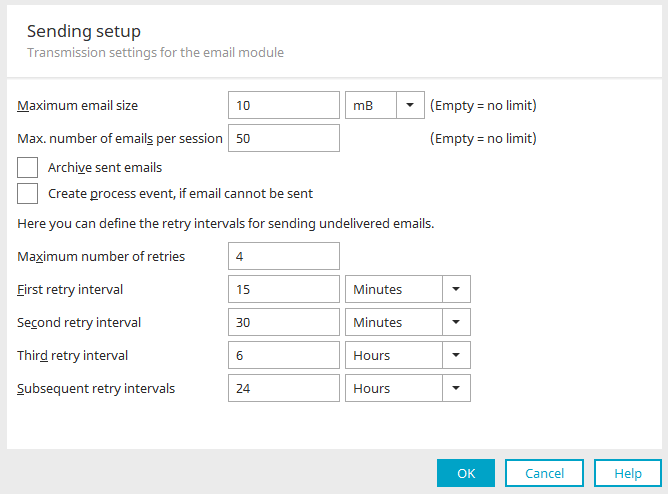
Maximum email size
Limits the size of outgoing emails. If this field is left blank, the size of the emails will not be taken into account. Select the desired unit from the drop-down list to the right of the size input field.
By default, there is a size limit of 10 MB here. This corresponds to the typical maximum expected message size.
Maximum number of emails per session
Here, you can set a limit on the maximum number of emails per SMTP session. If there are multiple emails ready to be sent at the same time, the SMTP session is terminated once this limit is reached, and a new SMTP session is created during the next iteration of the sending loop to send additional emails. The wait time between two iterations of the send loop is determined by the property de.uplanet.lucy.sendmail.sleepInterval (default value: 1000 ms).
Archive Sent Emails
With this setting, sent emails are stored in an archive file. You can change the corresponding path in the advanced settings.
Create a process event if an email cannot be sent
If this setting is enabled, after an email delivery has definitively failed, a
de.uplanet.lucy.server.mailservice.workflow.event.IBadMailWorkflowEvent
generated, which can be handled, for example, using the generic event handler
de.uplanet.lucy.server.mailservice.workflow.eventhandler.BadMailWorkflowEventHandler
can be responded to.
You can find more information on this here.
Maximum Number of Repetitions
This setting determines how many times the system will retry sending an undeliverable email.
Repetition Intervals
Set the duration of the first, second, third, and subsequent repetition intervals here. Each interval is calculated starting from the time of the most recent attempt.
We recommend keeping the settings for resending messages as they are set by default here.
Click "Next."
Connection Test
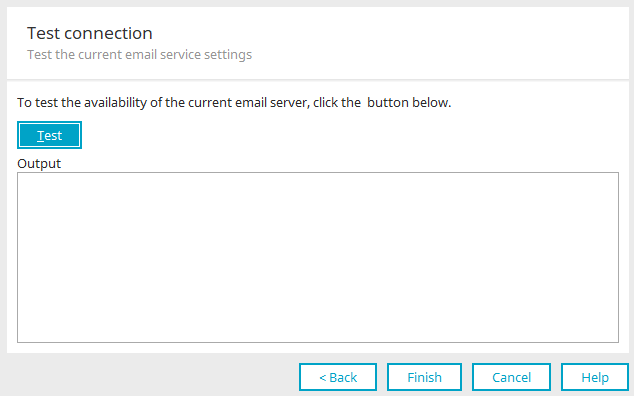
Click the "Test" button to test the configuration. If error messages appear, the configuration must be changed, or there is no mail server that can be used for the SMTP service. If you have any questions, please contact your system administrator.
Click "Finish" to save the email service configuration and close the wizard.
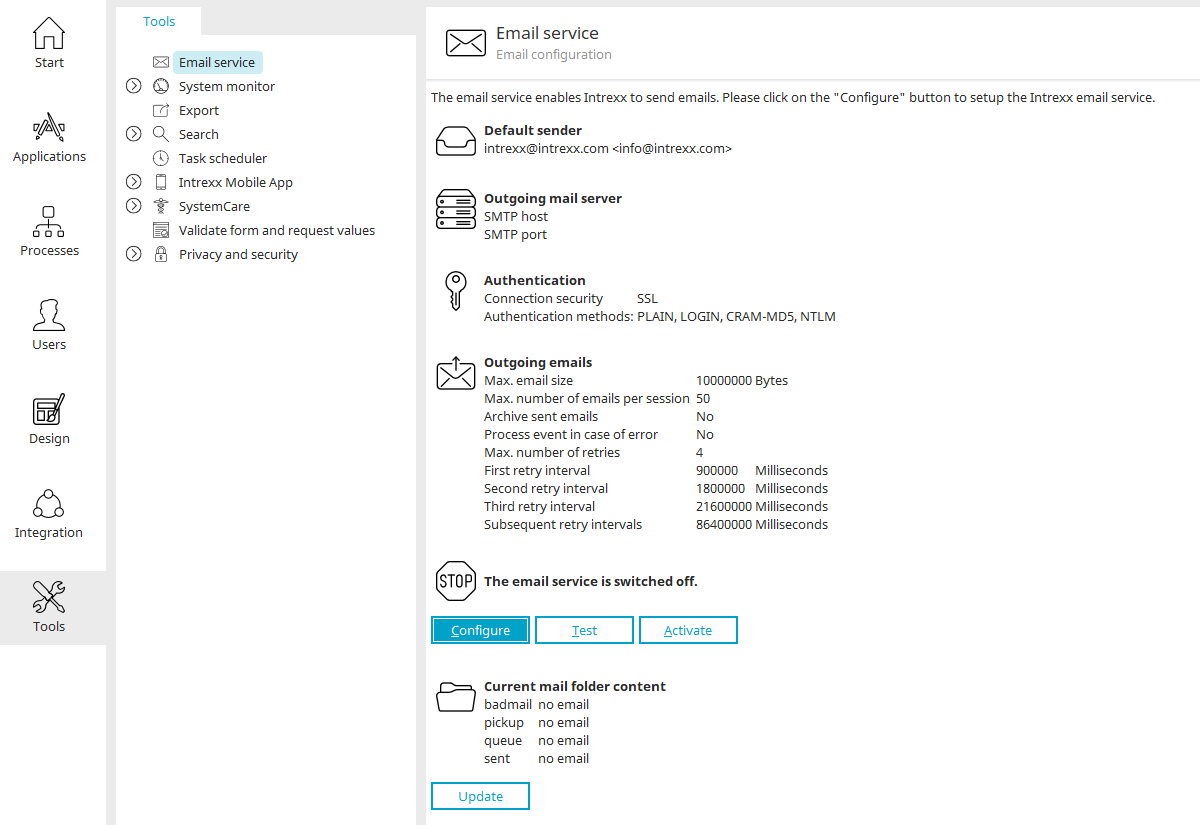
Once the email service has been set up, the settings will be displayed in the right-hand pane. You can enable, disable, or update the email service here by clicking the corresponding buttons.
If you click "Configure" again here, the configuration overview will open. In addition to the settings you're already familiar with, you'll find the advanced settings here.
Advanced Settings
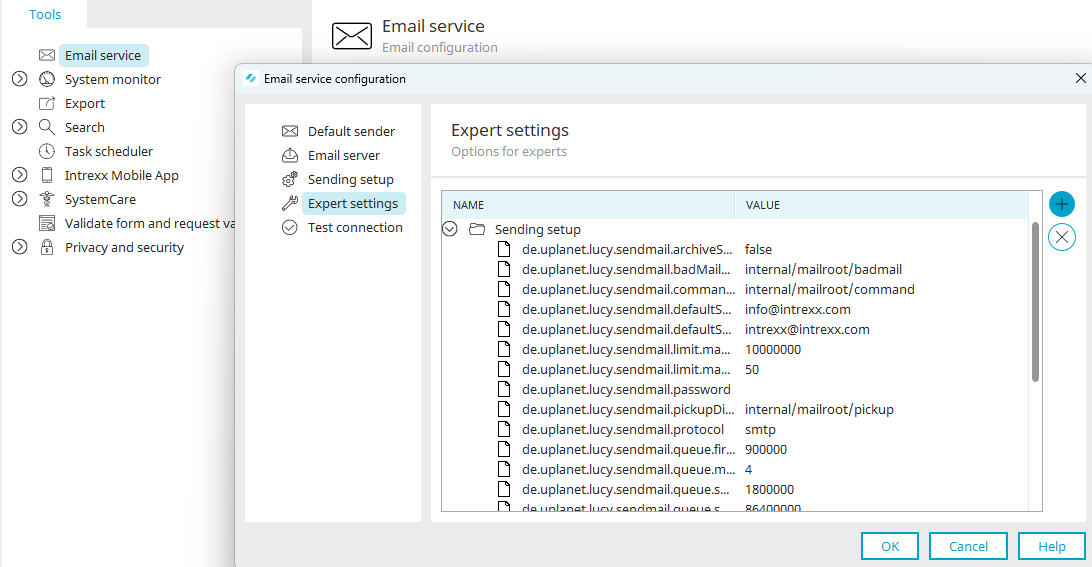
You can edit the value of a transmission setting by double-clicking it.
 Add a setting
Opens a dialog box where you can create a new property.
New Feature
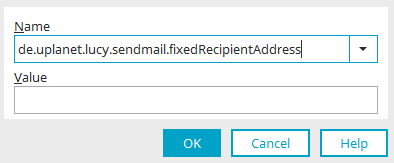
In the "Name" field, select the desired JavaMail property and enter its value. You can also enter your own properties directly here. You can find information about the available settings here.
Determine which portal the message was sent from
Global headers can be set when sending emails. These are set in every email sent through the Intrexx email service. It is a common convention to prefix the names of custom headers—those not defined by standards—with "X-". To define a global header, set the new property de.uplanet.lucy.sendmail.header in the expert settings as described above. followed by a sequential number, such as here, for example:
de.uplanet.lucy.sendmail.header.1
In the key value, enter the prefix "X-", the header name, followed by a colon and the portal name, as shown here, for example:
X-Intrexx-Portal:MeinPortal
This allows you to filter all emails sent from the MeinPortal portal, for example, in Outlook. In our example, the message header would be X-Intrexx-Portal:MyPortal.
Click "OK" to save the new setting and close the dialog box.
 Delete Setting
Removes the currently selected property.
Set the path for the email archive
In the sending settings, you'll find the option "Archive sent emails." The directory where archived emails are stored is specified by the de.uplanet.lucy.sendmail.sentMailDirectory setting and can be changed here.
Gmail as an email provider
As of May 2022, you can no longer use the password associated with your Google account to use Gmail as your email provider in Intrexx.
Instead, you must now use what is known as an app password. To do this, two-factor authentication must be enabled in your Gmail account.
In existing portals, the problem can be identified by errors of the following types:
            Error:
        javax.mail.AuthenticationFailedException:
        534-5.7.9 Application-specific password required. Learn more at 534 5.7.9
        https://support.google.com/mail/?p=InvalidSecondFactor y12-20020a170906470c00b00711d0b41bcfsm2837429ejq.0 - gsmtp