

Intrexx Architecture
Before you begin the installation, it is helpful to understand some key concepts of the Intrexx architecture.
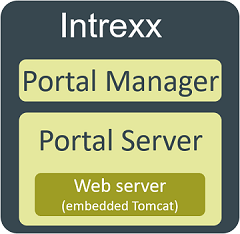
Portal Server, Portal Manager, Embedded Tomcat (Web Server)
Intrexx consists of the following two core components: Portal Server and Portal Manager
Portal Server Your portals run on the Portal Server. The server does not have a graphical user interface. Each portal on the portal server runs as a separate service in a Windows environment. The name of the service is "Intrexx Portal [MyPortal]". During the upgrade, you will be prompted to restart this service.
Portal Manager The Portal Manager is the Intrexx component that allows you to create and manage portals.
Web Server (Embedded Tomcat) Starting with version 19.03, Intrexx includes an embedded web server as an integral part of the software. This is Apache Tomcat.
So, if you upgrade from Intrexx 18.03 (or an earlier version) to Intrexx Silent Track, the embedded Tomcat will be installed automatically. This may result in a fundamental change to your current Intrexx configuration, as you will no longer need your own web server to run your portal.
(For detailed information about Apache Tomcat, see the following link: https://tomcat.apache.org)
Distributed Installation
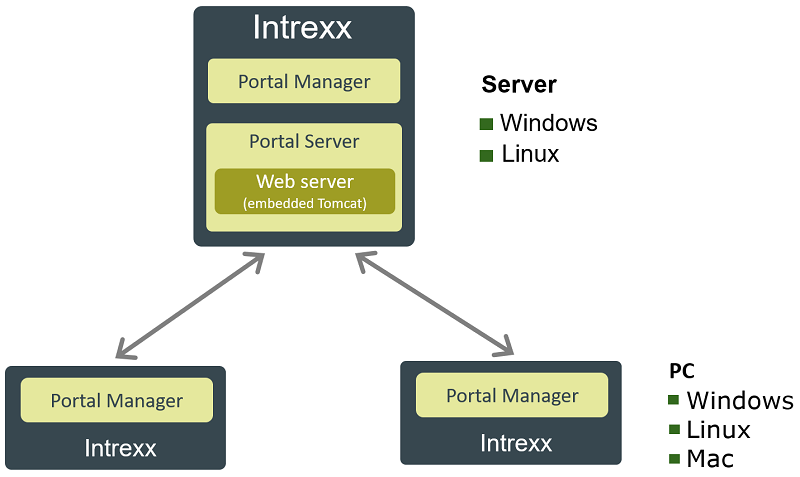
The Portal Manager and Portal Server (including the embedded Tomcat) are typically installed on a physical or virtual server first. As a rule, additional instances of the Portal Manager are also installed on other computers.
How It Works in a Distributed Installation
Regular daily tasks in Intrexx are performed using the Portal Manager, which is installed on a PC.
These include, for example, creating applications, setting up and configuring processes, and developing designs.
You must perform certain tasks using the Portal Manager installed on the server.
Tasks that occur rather irregularly, such as performing error analyses or upgrades, are carried out on the portal server.
In a distributed installation, you can assign permissions on a granular basis. This means that users of Portal Manager, which is installed on a PC, do not need any special permissions on the server.
Accessing Multiple Portal Servers
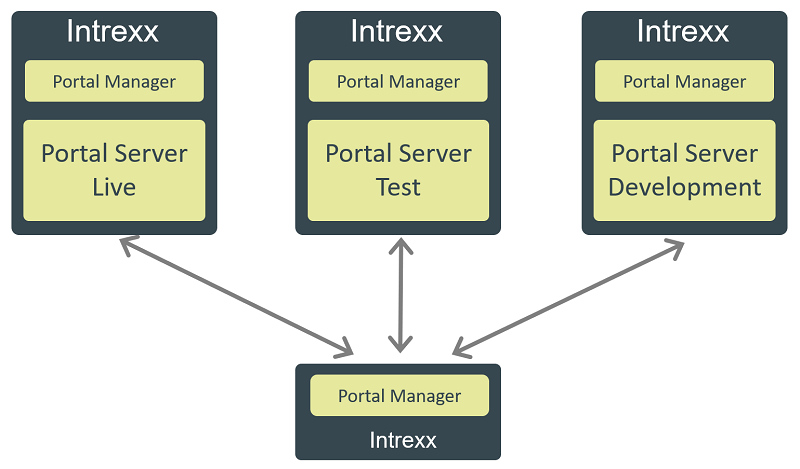
Using a Portal Manager (installed on a PC), you can connect to various portal servers. Once Portal Manager is running, you can switch to a different portal server.
Portals
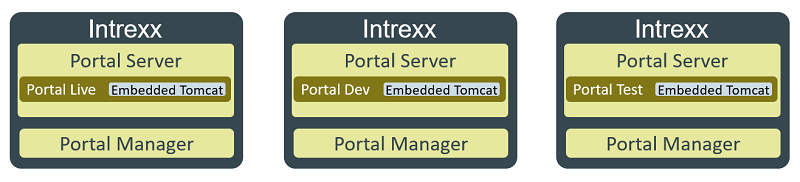
You can run multiple portals using Intrexx or on the Intrexx Portal Server.
These may include multiple production portals, as well as separate development and test portals. Each time a new portal is created, a new embedded Tomcat instance is deployed.
Production portals and test and development portals should be deployed on separate Intrexx portal servers. This allows you to test updates or upgrades on the test or development portal first before installing them on your production portal.
Portal and Database
When you create a new portal in Intrexx, Intrexx prompts you to select a database server and either create a new database or use an existing (empty) database.
You must install your preferred database server or database type before installing Intrexx. The database server can be installed on the same (physical or virtual) server on which Intrexx is installed.
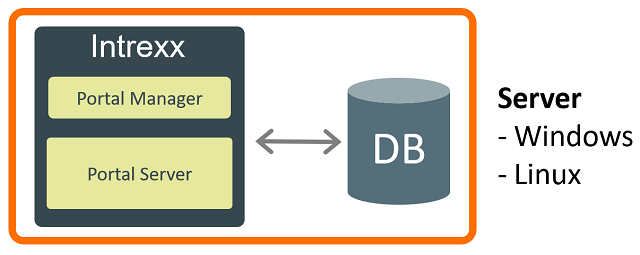
Intrexx and the database server can also be installed on different (physical or virtual) servers.
Use a Front-End Web Server (Reverse Proxy)
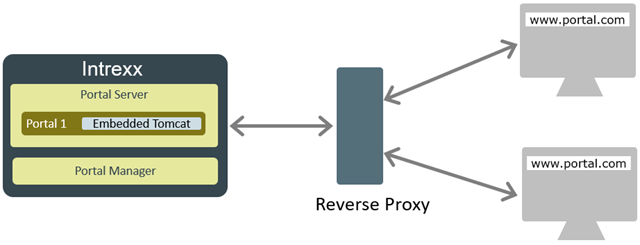
A front-end web server (reverse proxy) is typically used in conjunction with Intrexx. In most cases, these are Microsoft IIS or NGINX.
Neither product is part of Intrexx. They are not included with Intrexx.
There are many reasons why using a reverse proxy is recommended. In particular, an existing Windows authentication can be used for portal access via a reverse proxy.
Note: Installing and configuring the reverse proxy is a significant part of installing or upgrading from Intrexx 18.03 to Intrexx Silent Track.
There are key changes here compared to previous versions of Intrexx regarding the use of websites instead of virtual directories. This is also reflected in the corresponding input fields in the portal properties, which you must maintain in the Portal Manager.
This online help contains key information regarding IIS for installing or upgrading Intrexx.
At the same time, it may be helpful for you to familiarize yourself more thoroughly with the features of IIS. The same applies to NGINX.
In principle, a portal can be accessed even without a reverse proxy. However, this is only recommended for test and development portals.
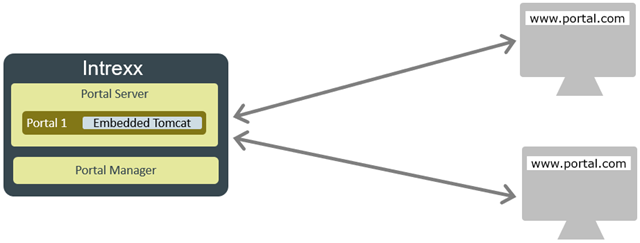
For production portals, you should use a reverse proxy.
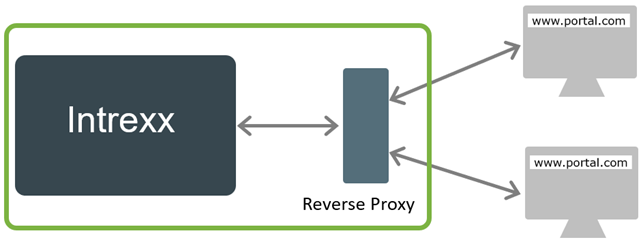
Intrexx and Reverse Proxy on a Single Server
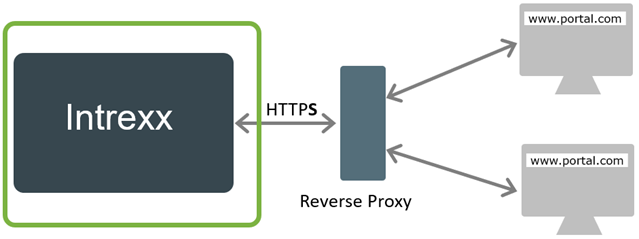
Intrexx and the reverse proxy can be installed on a (physical or virtual) server. In this case, an encrypted connection between the Intrexx server and the proxy server is not required, since communication takes place locally on the same physical server. Encrypted communication (SSL/HTTPS) is required between the reverse proxy and the browser. Encryption is configured in the reverse proxy and performed by it.
Intrexx and Reverse Proxy on Different Servers
Intrexx and the reverse proxy can also be installed on different (physical or virtual) servers. In this case, it is recommended to encrypt not only the connection between the reverse proxy and the browser, but also the connection between Intrexx and the reverse proxy, since communication here already takes place over a network.
Ports
Embedded Tomcat: By default, Embedded Tomcat listens on port 1337. During a new installation, Intrexx uses this port. For each additional portal, Intrexx increments the port number by one. When upgrading, you can keep the port from the previous version's installation.
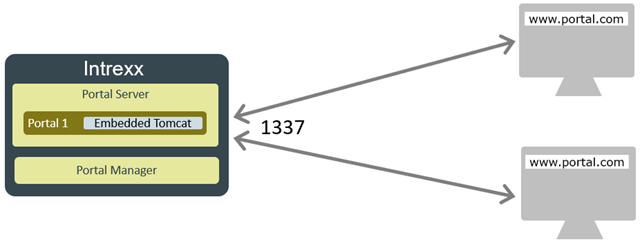
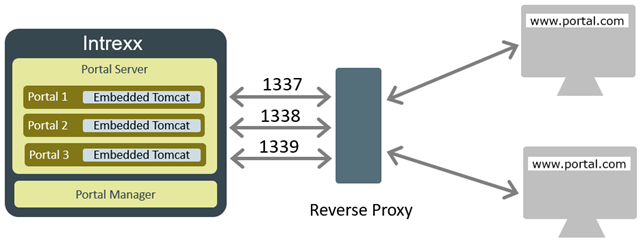
Note: Port 1337 is the default setting for a new installation of Intrexx 21.03. When you upgrade, Intrexx will retain the port you used in a previous version of Intrexx. You can leave this port as is. Reverse Proxy By default, the reverse proxy (IIS) listens on port 80 when you set up an HTTP connection. The reverse proxy listens on port 443 when you set up an HTTPS connection. Starting with Intrexx 19.03, you must set up an HTTPS connection.
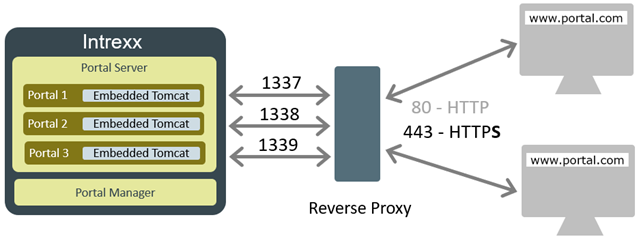
Note: Please be aware that you may need to open these ports in your firewall. This may be necessary, especially if you change ports during the upgrade.