API permissions for the Connector for Microsoft 365 and Teams
You must configure the following API permissions in Microsoft Azure to use the Connector for Microsoft 365 and Teams.
Permission Types
The permissions are of the "Delegated" and "Application" types. Actions associated with "Delegated" permissions are performed by a (personal) Microsoft 365 user. The actions associated with "Application" permissions are performed by an Microsoft 365 service account.
Often, the same permission applies to both the "Delegate" and "Application" types. Depending on the use case, it may be desirable for an action to be performed by a regular user or by a service account. Accordingly, you can choose in Intrexx whether Intrexx should log in to Microsoft 365 using a (personal) user account or a service account.
For detailed information on this, see the sections " New Registration - Static User Accounts " and " New Registration - Service Accounts."
Please note that for "Application" permissions, an Entra ID (formerly Azure AD) administrator must grant administrator approval.
API Permissions
|
API/Permission name |
TYPE |
Description |
Administrator Consent |
|---|---|---|---|
| Calendars.Read | Delegated | Read Access to User Calendars | No |
| Calendars.Read.Shared | Delegated | View Users and Shared Calendars | No |
| Calendars.ReadWrite | Delegated | Has full access to user calendars. | No |
| Calendars.ReadWrite | Application | Read and write to calendars in all mailboxes | Yes |
| Channel.Create | Delegated | Create channels | Yes |
| Channel.ReadBasic.All | Delegated | Read the names and descriptions of the channels | No |
| Channel.ReadBasic.All | Usage | Read the names and descriptions of all channels | Yes |
| ChannelMessage.Read.All | Delegated | Read user channel messages | Yes |
| ChannelMessage.Send | Delegated | Send channel messages | No |
| Chat.Create | Delegated | Create chats | No |
| Chat.Read | Delegated | Read user chat messages | No |
| Chat.Read.All | Usage | Read all chat messages | Yes |
| Chat.ReadBasic | Delegated | Read the names and members of user chat threads | No |
| Chat.ReadWrite | Delegated | Read and Write User Chat Messages | No |
| Directory.Read.All | Application | Read directory data | Yes |
| Delegated | View users' email addresses | No | |
| Files.ReadWrite.All | Delegated | Full access to all files that the user can access | No |
| Group.Create | Application | Create groups | Yes |
| Group.ReadWrite.All | Application | Read and write for all groups | Yes |
| GroupMember.Read.All | Usage | View all group memberships | Yes |
| GroupMember.ReadWrite.All | Application | Read and write all group memberships | Yes |
| Mail.ReadWrite * | Delegated | Read and Write Access to User Emails | No |
| Mail.Send * | Delegated | Sending Emails Under a Different Username | No |
|
offline_access (OpenID Permissions) |
Delegated | Retain access to data for which you have granted access | No |
| Presence.Read | Delegated | Read the user's presence information | No |
| Presence.ReadWrite.All * | Usage | Read and write presence information for all users | Yes |
| profiles | Delegated | View Basic User Profiles | No |
| Sites.Read.All | Delegated | Read items in all website collections | No |
| Sites.Read.All | Application | Read items in all site collections | Yes |
| Sites.ReadWrite.All * | Delegated | Edit or delete items in all website collections | No |
| Team.Create | Delegated | Create teams | No |
| Team.Create | Application | Create teams | Yes |
| Team.ReadBasic.All | Delegated | Read the names and descriptions of the teams | No |
| Team.ReadBasic.All | Application | Get a list of all teams | Yes |
| TeamMember.ReadWrite.All | Delegated | Add and remove members from teams | Yes |
| User.Read.All | Application | Read all users' full profiles | Yes |

*optional
Setting API Permissions in Intrexx
In the Connector for Microsoft 365 and Teams, under the "Authentication" menu item, you must specify the permissions (scope) that Intrexx users or Intrexx service accounts should use to access Microsoft 365. You can set the permissions individually there. The individual permissions must be separated by a space.
You can also enter "https://graph.microsoft.com/.default" in the " Connector for Microsoft 365 and Teams." Intrexx users or Intrexx service accounts will then access Microsoft 365 using the permissions you granted at Microsoft Azure.
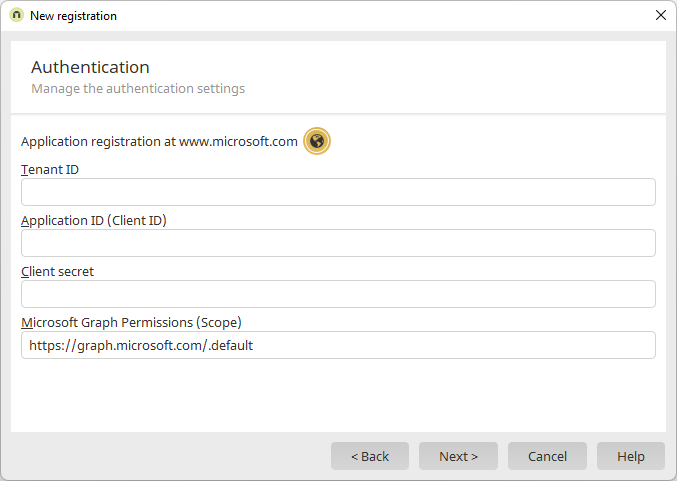
For detailed information on this, see the " New Registration - Authentication" section.