

Tab Menu

A tab menu can be used to group multiple pages together. Each embedded page can then be accessed via its own tab. You can access the relevant settings in the Page Properties dialog box on the "Tab Menu" tab.
Tab Menu - Properties
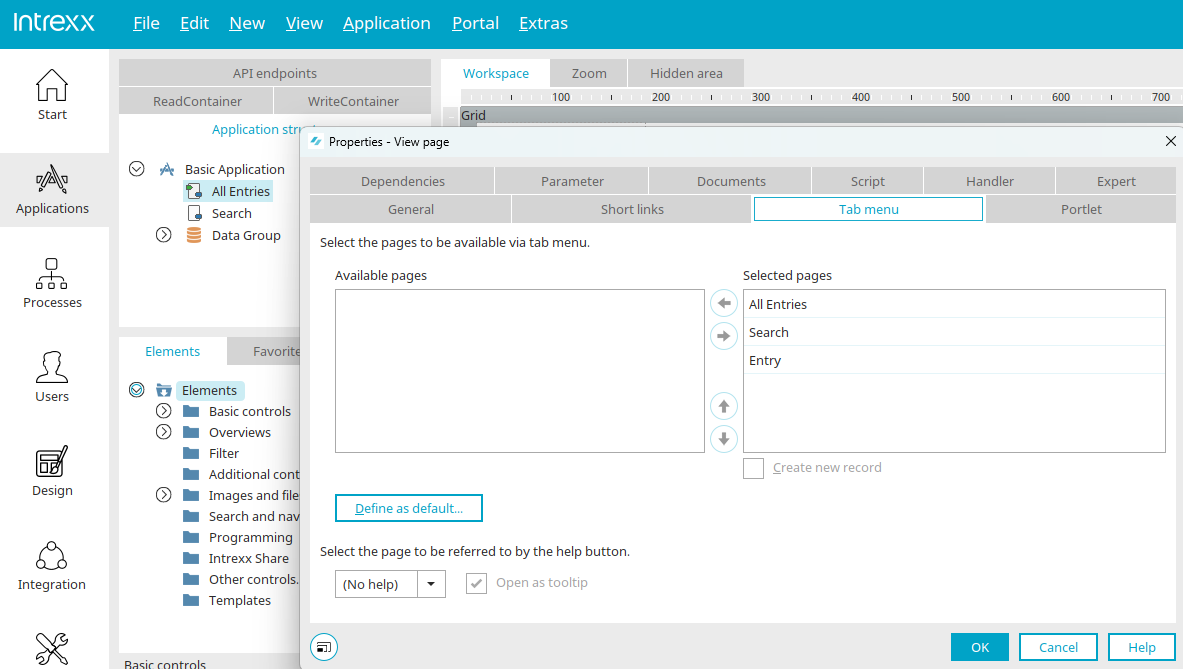
Available Pages / Selected Pages
For a tab menu, you can
-
All pages in the current data set
-
All parent pages
-
All input pages of a directly subordinate data group
be selected. All pages in the "Selected Pages" list are included as tabs in the tab menu. You can move pages from one list to another by clicking the horizontal arrow buttons 
 . You can use the vertical arrow keys
 to change the order of the pages. The higher a page is in the list, the further to the left it will appear in the tab menu.
Create as a new record
When you select an input page from the "Selected Pages" list, the "Create New Record" option is enabled. This ensures that all elements on the input page in the tab menu are loaded without data when you click the corresponding tab. At the same time, view pages are no longer accessible, while all other input pages in the menu are active.
Set as Default
Opens a dialog box where you can set the tab menu configured here as the default.
Set the Tab Menu as the Default
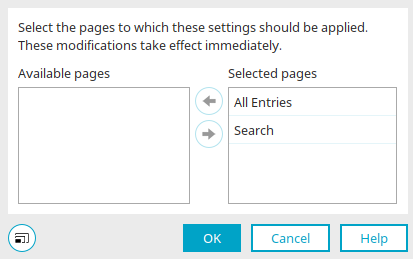
The tab menu you have defined will be automatically applied to all pages selected here. When you click "OK," the tab menu will be automatically configured for the selected pages.
Click "OK."
In the lower section of the dialog, you can select any view page of the application as a help page. A button will then appear in the browser to the right of the tabs in the tab menu; clicking it loads the help page. When the "Open in Tooltip" setting is selected, the help page is displayed in a tooltip. Without this setting, a pop-up window for the help page will open.